
How to Talk to Your Teen About Careers (Without the Eye Roll)
90% of high schoolers trust their parents for advice on life after high school, but parents bring up just 3 of 8 paths on average. The questions that open teens up, the ones that shut them down, and a 7-step script you can use tonight.
Founder of Ikigai · Career data + personality science
You ask one innocent question at dinner. "So, have you thought about what you want to do after graduation?" And you get the look. The eye roll, the shrug, the sudden urgent need to check a phone. Conversation over.
Here is the twist: your teen is listening more than it looks. In a 2025 Gallup and Walton Family Foundation survey, 90% of high school students said they trust their parents for advice about life after high school. Teachers came in at 54%. School counselors, 48%. Strangers on social media, 8%.
So you are the most trusted source in the room. The problem is usually not whether you talk, it is how. This guide covers the questions that open teens up, the ones that shut them down, and a short script you can try tonight.
The blind spot: 3 paths out of 8
Gallup asked about eight things a teen can do after high school: a bachelor's degree, a paid job, an associate degree, a certificate program, an apprenticeship, an internship, the military and starting a business. On average, parents had discussed just 3 of the 8 with their child.
The ones that get talked about are predictable. 68% of parents bring up a four-year degree and 64% bring up working a paid job. Fewer than half bring up any of the other six. And that matters, because students whose parents discuss a path were about twice as likely to show interest in it.
That is a big deal when you look at where the growth is. In our data, 51 careers are projected to grow 10% or more by 2035 while paying a median of at least $50,000 (with at least 10,000 jobs each). 16 of them are usually reached without a bachelor's degree: think certificates, apprenticeships and 2-year programs. If those paths never come up at home, a third of the best options are invisible.
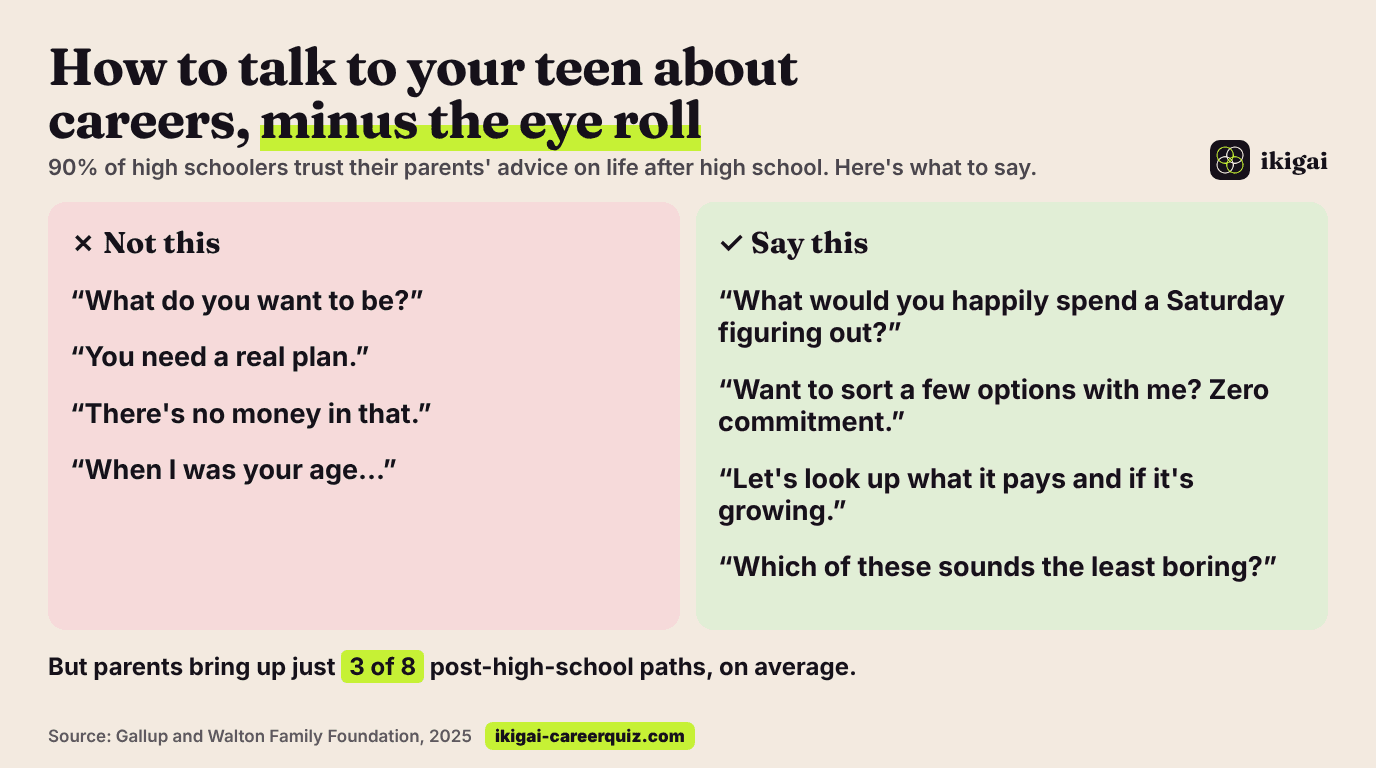
Say this, not that
Most conversation-enders are not mean. They are just big, vague or judgy. Teens hear "what do you want to be?" as "announce your entire future, now, with confidence." Swap the giant question for a small, specific one.
Why these work: they are easy to answer, they are about the present (what your teen already likes) rather than a far-off identity, and they make it a joint project instead of an interview. A few more principles:
Let them react, don't make them invent. Almost nobody, at any age, can pull a dream job out of thin air. But nearly everyone can look at eight options and say "ew, no" to five of them. Reactions are data. The "no way" pile tells you as much as the "maybe" pile.
Ask about the why behind the no. "Nurse? No way." Is that blood, night shifts, or talking to strangers all day? Each answer points somewhere different. A teen who hates blood but loves helping people might light up at physical therapy.
Bring numbers, not opinions. "There's no money in that" starts an argument. "Let's look it up" starts a project. Data takes you off the hook as the bad guy, and sometimes the data surprises both of you. (We covered the most common outdated instincts in 5 things parents get wrong about career advice.)
Talk side by side, not face to face. Plenty of parents swear by the car, the kitchen or a walk. No eye contact, a natural end point, and nobody feels cornered.
A starter menu to react to
Here are 8 careers to put in front of your teen. Every one is projected to grow by double digits through 2035, and they span five kinds of paths, from on-the-job training to grad school. Five of the 8 are hands-on or care roles, on purpose: those are the paths that tend to get skipped at the dinner table.
A wind turbine technician and a data scientist are both growing about 30%. One climbs towers, the other wrangles spreadsheets. Your teen's reaction to that pair alone tells you something useful. Want a longer list? Our best careers for high school students post sorts dozens by entry path.
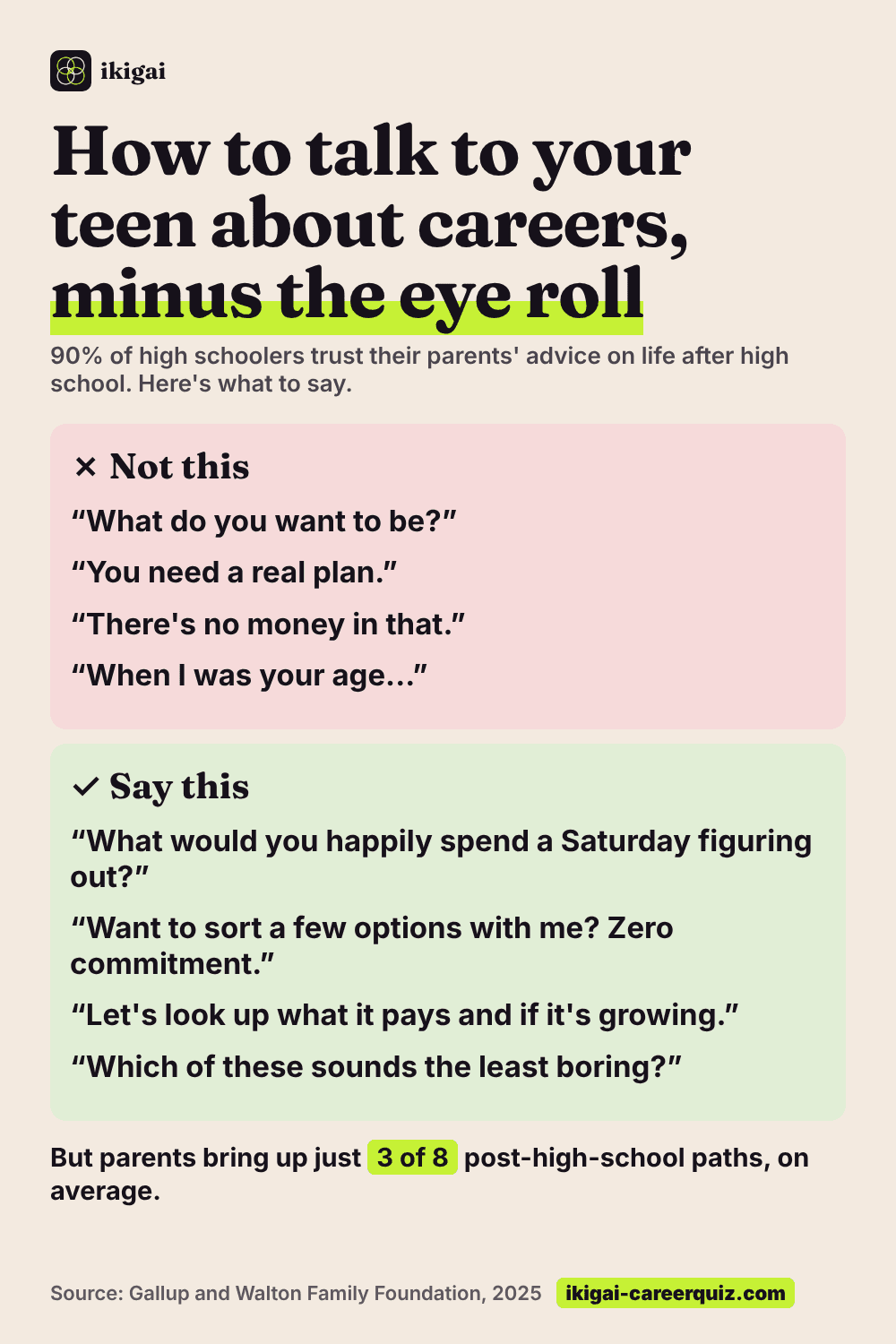
Save the cheat sheet
Four conversation-enders and what to say instead. Pin it for the next time "so what's the plan?" is on the tip of your tongue.
Save to PinterestA 7-step script for tonight
Twenty minutes, one snack, no lecture. Adjust the words so they sound like you.
- Pick a low-stakes moment. A drive, cooking, a walk. Not right after a bad grade, and not in front of relatives.
- Lower the stakes out loud. "This is not a big decision talk. I just found a list and I'm curious what you think."
- Start with the present. "What's something you could do for hours without noticing the time?" Games, fixing things, drawing, organizing a group chat, all of it counts.
- Show the menu. Pull up the 8 careers above and ask them to sort each into "maybe," "no way" or "what even is that?"
- Get curious about the no-ways. "What about it is a no?" Listen more than you talk. Resist the urge to sell.
- Look one up together. Pick a "maybe" and check the pay, the growth and how people get in. Name all the routes, including apprenticeships, certificates and the military, not just college.
- End with one tiny next step, then stop. Watch a "day in the life" video, ask a relative who does the job, or take a quiz. Then let it go before they want to. Ending early makes round two easier.
If step 4 gets a shrug, that is normal. Try a different moment next week. Gallup found only about 4 in 10 students had thought "a lot" about their future career (about half of seniors), so "I don't know" is the default, not a red flag.
Why "growing by the time they start" is the point
A 15 year old today will probably start full-time work somewhere between 2029 and 2034, depending on the path. That is why we lean on projections through 2035 rather than which jobs are hot right now. It also gives you a neutral way into the "but will it pay" conversation: you are not judging their dream, you are both looking at where the tailwinds are.
One honest caveat: projections are educated guesses about the next decade, not promises. Some creative fields are growing slowly in the data, and people still build great careers in them. The goal is to widen the menu, not to steer your teen away from what they love.
Let the quiz start the conversation for you
If a blank "so, what are you thinking?" keeps falling flat, give your teen something to react to. Our quiz takes about 7 minutes, maps their interests, strengths and values (including how hands-on they like their work), asks what year they expect to start working, and ranks all 952 careers in our database by fit and projected growth by then. Then you can talk about their results instead of your guesses. More on how it works for teens in our career quiz for high school students guide.
Parents, here is how Ikigai helps your teen explore careers. Or send them straight to the quiz and compare notes after.
Sources: Gallup and Walton Family Foundation, "Voices of Gen Z" study on post-high school pathways (published June 2025; surveyed April 15 to 25, 2025; 1,257 high school students and parents of 16 to 18 year olds): share of students who trust each source of advice (parents 90%, teachers 54%, counselors 48%, social media posts by strangers 8%), parents discussing an average of 3 of 8 pathways, 68% raising a four-year degree and 64% a paid job, students about twice as likely to show interest in paths their parents discuss, and 4 in 10 students having thought "a lot" about their future career. Career growth (2025 to 2035), employment and median pay from BLS Employment Projections and OEWS (May 2025); "without a bachelor's" means O*NET Job Zones 1 to 3, counted among careers with growth of 10% or more, median pay of $50,000 or more and at least 10,000 jobs, via scripts/blog-how-to-talk-to-your-teen-about-careers.ts. Paths shown are typical routes, not requirements. Conversation tips are general guidance, not clinical advice.
Liked this article?
Get weekly career insights backed by real labor market data. Free, no spam.
Keep reading
Find your Future-Fit Career
7-minute personality quiz. 952 careers. Real BLS data. No account needed.
Take the quiz →