
Is College Still Worth It in 2026? What the Data Actually Says
A bachelor's still pays 63% more per week than a high school diploma, yet 42% of recent grads work jobs that do not need one. Here is when college clearly pays off, when to think twice, and the careers where a shorter path reaches the same pay.
Founder of Ikigai · Career data + personality science
Ask the internet whether college is worth it and you get two loud camps. One says a degree is a scam. The other says skipping it is career suicide. Both are selling something, and neither is looking at the same numbers you are.
So here are the numbers. Two of them, actually, and they seem to contradict each other:
- A worker with a bachelor's degree earns a median of $1,578 a week. A worker with only a high school diploma earns $966. That is about 63% more, or roughly $31,800 a year.
- And yet 42% of recent college grads are working jobs that typically do not require a degree, according to the New York Fed.
Both are true. The honest answer to "is college worth it?" is not yes or no. It is "for which degree, at what price, aimed at which career?" Let's go through it the way a smart friend with a spreadsheet would.
The case for college: the averages still win
The U.S. Bureau of Labor Statistics publishes the same chart every year, and the 2025 version looks a lot like the last decade of them. More school, more pay, less unemployment:
- High school diploma: $966 a week, 4.3% unemployment
- Associate degree: $1,135 a week, 3.0% unemployment
- Bachelor's degree: $1,578 a week, 2.8% unemployment
- Master's degree: $1,876 a week, 2.6% unemployment
Graduates mostly agree. In Gallup surveys published in February 2026, 71% of college graduates said their degree was worth the cost, and 80% of bachelor's grads said it had been important or critical to reaching their career goals.
The price is also lower than the headlines suggest. The College Board puts average published tuition and fees at a public four-year college, in-state, at $11,950 for 2025-26. After grants, the average student there pays an estimated $2,300 in net tuition and fees (housing and food are extra, and they are often the bigger bill).
The case against: the averages hide a lot
Averages blend the nursing major and the undecided sophomore who drifted into a degree. Pull them apart and the picture gets messier.
Recent grads are having a rough time. The New York Fed puts unemployment for college grads aged 22 to 27 at about 5.6% in the second quarter of 2026, higher than for workers overall. A few years ago that would have been strange. Now it is the norm.
Your major matters more than the diploma. In the New York Fed's breakdown, 65.8% of recent criminal justice grads and 63.9% of performing arts grads were underemployed. Nursing grads had 2.1% unemployment and special education grads just 0.7%. Even computer engineering, the classic "safe" major, posted 7.8% unemployment, second highest of any major. (We dug into the majors grads regret most in a separate post.)
Not finishing is the worst of both worlds. Workers with some college but no degree earn $1,062 a week, much closer to the diploma than the degree, and many of them still carry the loans.
And cost is pushing people out. In EAB's 2026 survey of recent high school grads who did not enroll, 67% named cost of living as their main reason, up from 51% a year earlier.
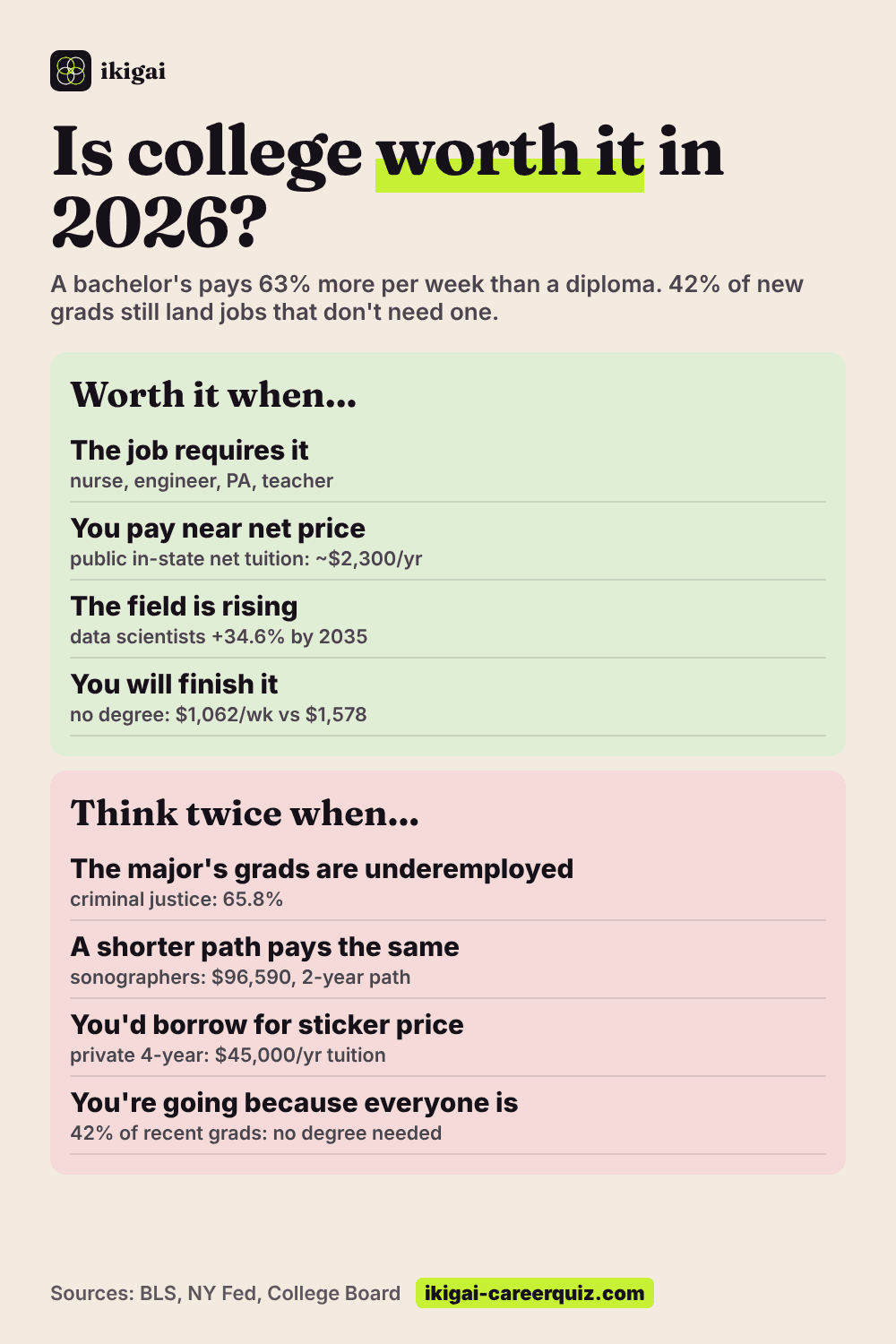
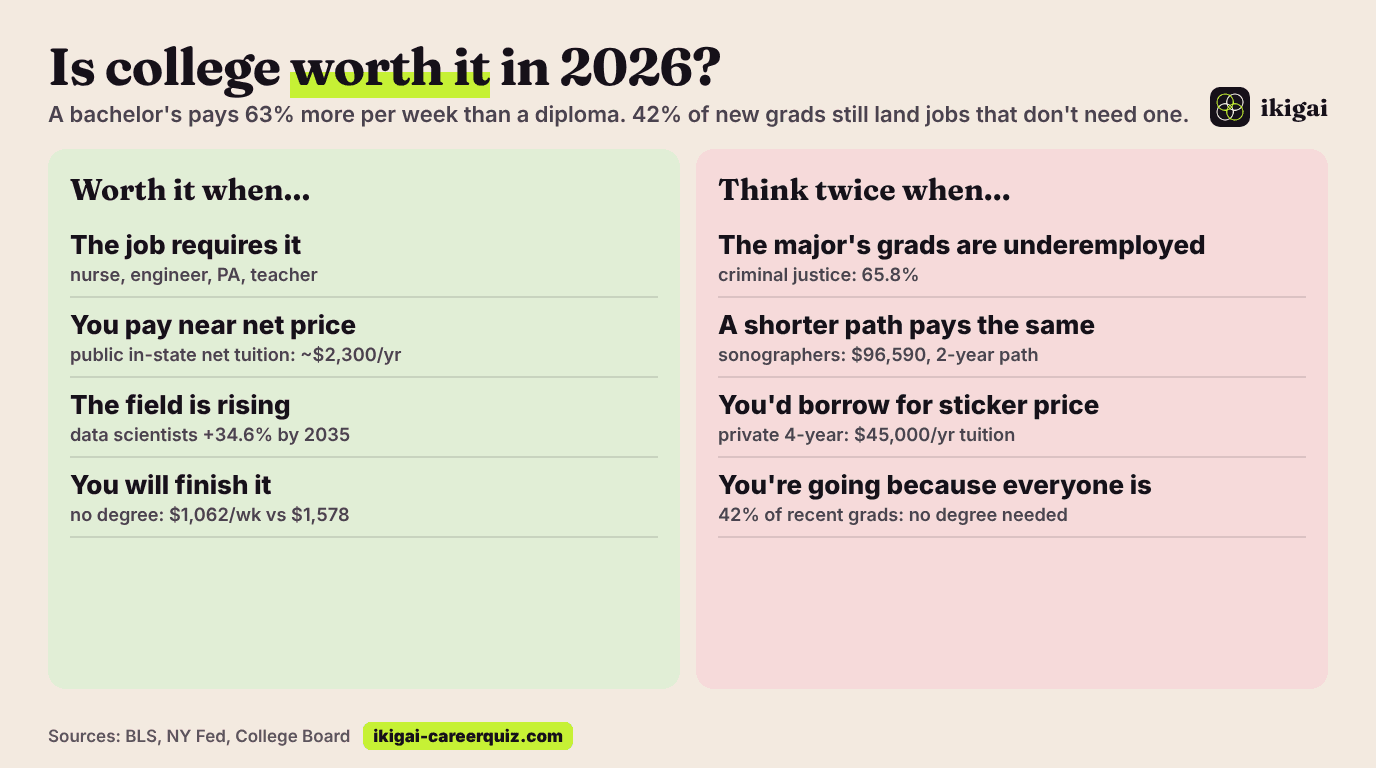
Save the chart
Four signs college is a strong bet, four signs to slow down. Useful at the kitchen table before anyone sends a deposit.
Save to PinterestThe question nobody asks: which career, in which year?
Here is where most "is college worth it" articles stop. They compare degree holders to everyone else, today. But if you are in high school, you are not entering today's job market. You are entering the one in 2029 or 2032. So we looked at what the BLS projects for 2025 to 2035 (all U.S. jobs combined: +3.5%) and asked a sharper question: for which careers is the bachelor's clearly the ticket, and for which does a shorter path get you to the same paycheck?
Where the bachelor's clearly pays off
These careers usually require a four-year degree, pay a median of $100k or more, and are projected to grow well above average:
Notice the theme: data, security, health care management, engineering. The degree is not a vague credential here. It is the specific training the job runs on. That is when college math tends to work best.
Where a shorter path reaches the same pay
The typical bachelor's holder earns about $82,000 a year ($1,578 times 52). In our database, 18 careers that do not usually need a bachelor's have a higher median than that and are still projected to grow. A few of the strongest:
Several of these start as paid apprenticeships, so instead of borrowing you earn while you train. They are not consolation prizes. A sonographer out-earns the median bachelor's holder by about $14,500 a year and can be working by 20. For more like this, see trade careers making six figures and our list of careers without a degree.
One honest caveat: these are the standouts, not the rule. Only about 7% of the non-bachelor's occupations in our data clear that $82,000 bar. The shorter path pays off when you aim it at a specific, in-demand career, which is exactly the same lesson as the degree.
So, is it worth it? A 4-question gut check
- Can you name a career (or two) the degree points toward? Not a forever answer, just a direction. If the answer is "no idea," that is normal, and a cheap way to explore first (community college, a gap year with a plan, a job) may cost less than four undecided years.
- Is that career rising when you would graduate? Check the 2035 projection, not today's headlines.
- What will you actually pay? Net price after grants, not sticker price. Every college has a net price calculator on its site. Compare it to the starting pay of the careers you named.
- Is there a shorter route to the same place? If a two-year program or apprenticeship leads to the same pay, that is worth weighing seriously, not as a backup.
If you are still picking a field, our guide on how to choose a college major walks through it step by step.
What this data cannot tell you
These are national medians and 10-year projections. They cannot see your state, your scholarship offer, a surprise technology shift, or how much you would enjoy the work. The earnings figures compare all workers 25 and over by education, which mixes in age, field and plenty of other factors, so they show a pattern, not a guarantee. Treat everything here as a way to ask better questions, not as a verdict.
Start with the career, then pick the path
The pattern in all of this is simple: college works best as a means to a specific end. Our quiz takes about 7 minutes, maps your interests, strengths and values, asks what year you expect to start working, and ranks all 952 careers in our database by fit and projected growth by then. Each match shows how people usually get in, degree or not. Teens can read more in our career quiz for high school students guide.
Take the quiz and see which rising careers fit you. Parents, here is how Ikigai helps your teen explore careers.
Sources: Median weekly earnings and unemployment by educational attainment (2025, ages 25+, full-time wage and salary workers; 11-month average excluding October 2025) from BLS, "Education pays, 2025," Career Outlook (September 2026). Recent-grad unemployment (about 5.6%) and underemployment (42%), 2026 Q2, from the Federal Reserve Bank of New York, "The Labor Market for Recent College Graduates." Major-level unemployment and underemployment (2024 Census data) from the same NY Fed study, as reported by Forbes (February 23, 2026). Graduate views (71% worth the cost; 80% of bachelor's grads say important or critical) from Gallup (February 23, 2026). Published tuition ($11,950 public four-year in-state; $45,000 private nonprofit four-year) and estimated net tuition ($2,300) for 2025-26 from College Board, Trends in College Pricing and Student Aid 2025. Non-enrollment reasons (67% cost of living, up from 51%) from EAB, via Higher Ed Dive (2026). All-jobs growth (3.5%, 2025 to 2035) from BLS, The Economics Daily (September 21, 2026). Career growth (2025 to 2035), employment and median pay from BLS Employment Projections and OEWS (May 2025), via scripts/blog-is-college-worth-it-2026.ts. Entry paths are typical routes by O*NET Job Zone, not requirements.
Liked this article?
Get weekly career insights backed by real labor market data. Free, no spam.
Keep reading
Find your Future-Fit Career
7-minute personality quiz. 952 careers. Real BLS data. No account needed.
Take the quiz →