
What's Your Holland Code? The 6 RIASEC Types, Explained With Real Careers
The Holland code (RIASEC) sorts people into 6 interest types. Here is each one in plain English, how 3-letter codes work, and the fastest-rising careers for each type, like nurse practitioners (+41.0% by 2035).
Founder of Ikigai · Career data + personality science
If you have ever taken a career test at school, there is a good chance it quietly sorted you into one of six boxes. Realistic. Investigative. Artistic. Social. Enterprising. Conventional. Put the first letters together and you get RIASEC, which sounds like a pharmaceutical brand but is actually one of the most widely used maps of career interests out there.
Your mix of those six types is called your Holland code. It is also the engine under the hood of our own quiz, so this post doubles as a peek at how Ikigai works.
Here is what surprised us when we ran the numbers on all 952 careers in our database: the most common top type is not the one most career advice is written for. 389 of them (41%) are Realistic, the hands-on type. And the type with the fewest options is the one schools romanticize most.
Who was Holland, and why a hexagon?
John L. Holland (1919 to 2008) was an American psychologist, later at Johns Hopkins University, who argued that people and jobs both come in a handful of recognizable flavors. In 1959 he published "A Theory of Vocational Choice" in the Journal of Counseling Psychology, and in 1973 he laid out the full model in his book Making Vocational Choices. His big idea was simple: people are happier and stick around longer in work environments that match their interests.
He arranged the six types around a hexagon in the order R, I, A, S, E, C. Types that sit next to each other (Realistic and Investigative, say) have a lot in common. Types on opposite sides (Realistic and Social, Artistic and Conventional) tend to pull in different directions. Researchers have tested this for decades. The neighbors-are-similar pattern holds up well, even though the real shape is a bit lopsided rather than a perfect hexagon.
Today the U.S. Department of Labor's O*NET system tags every occupation with a score on all six types, and it sponsors the O*NET Interest Profiler, the RIASEC questionnaire our quiz's interest section is built on.
How a 3-letter code works
Nobody is just one type. Your Holland code is your top three types in order. An RIC person is hands-on first, curious second, and likes things orderly third. An SAE person loves people, creativity and taking the lead.
Jobs get codes too. In our data the single most common job code is RCI (hands-on, organized, problem-solving), shared by 206 occupations, from industrial machinery mechanics to wind turbine technicians. Across all 952 careers there are 90 different 3-letter combinations, which is why two people with the same first letter can still end up in very different places.
The 6 types, with real rising careers
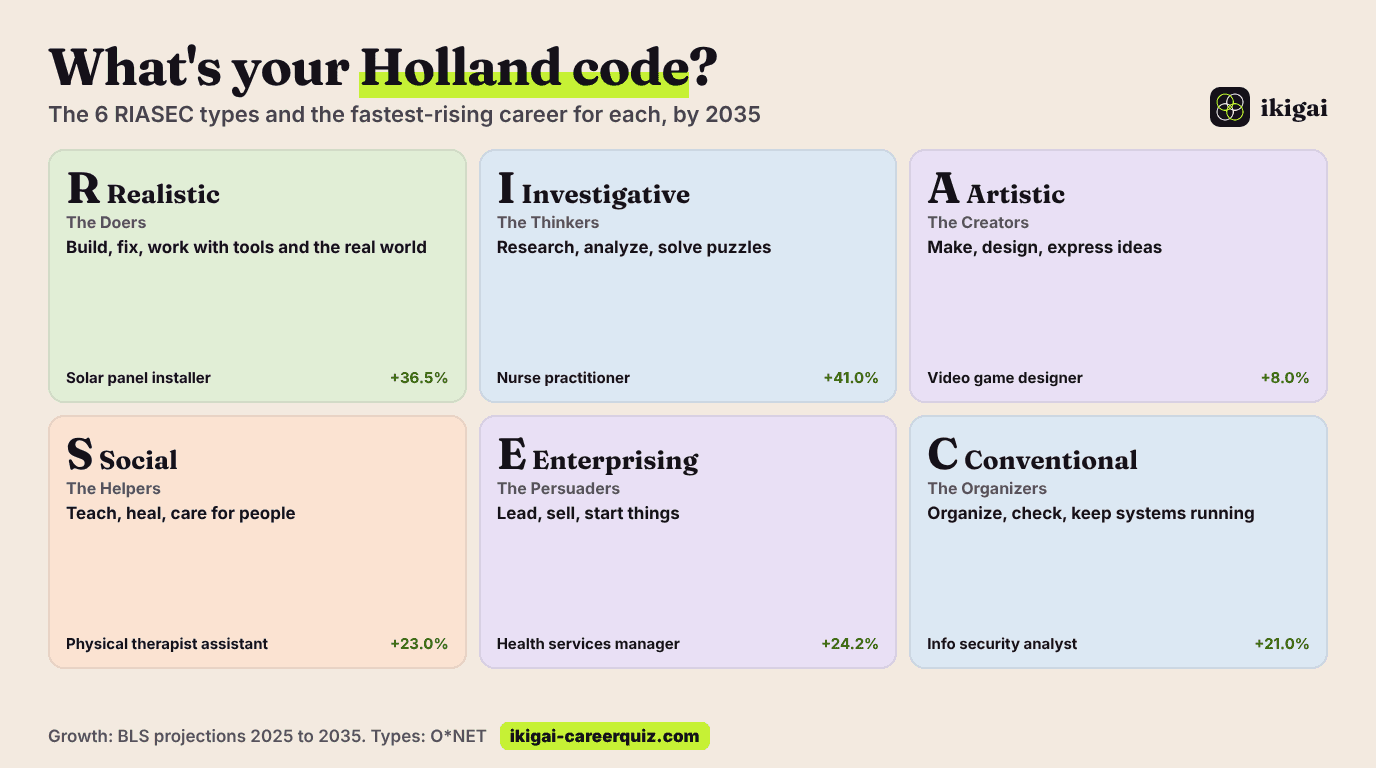
For each type: what it looks like in real life, how many careers in our database have it as their top type, the median pay across them, the share projected to grow at least 8% from 2025 to 2035, and the two fastest-rising careers (with at least 10,000 U.S. jobs) where it is the top type.
You like working with your hands, tools, machines, plants or animals. You would rather fix the thing than write a report about the thing.
Energized by: Building, repairing, being outdoors, seeing a finished result
You like figuring out how and why things work. Puzzles, research, data and science problems that do not have an obvious answer yet.
Energized by: Analyzing, experimenting, asking why one more time
You like making things that did not exist before: art, music, writing, design, games. Rules feel optional.
Energized by: Self-expression, originality, unstructured time
You like teaching, healing, coaching and caring for people. Energy comes from other humans, not from spreadsheets.
Energized by: Helping, explaining, supporting someone through something
You like leading, selling, deciding and starting things. You are comfortable taking a risk if the payoff is real.
Energized by: Persuading, organizing people, competing, closing the deal
You like order, accuracy and clear procedures. You notice the error everyone else missed and you enjoy fixing it.
Energized by: Organizing, checking details, keeping systems running
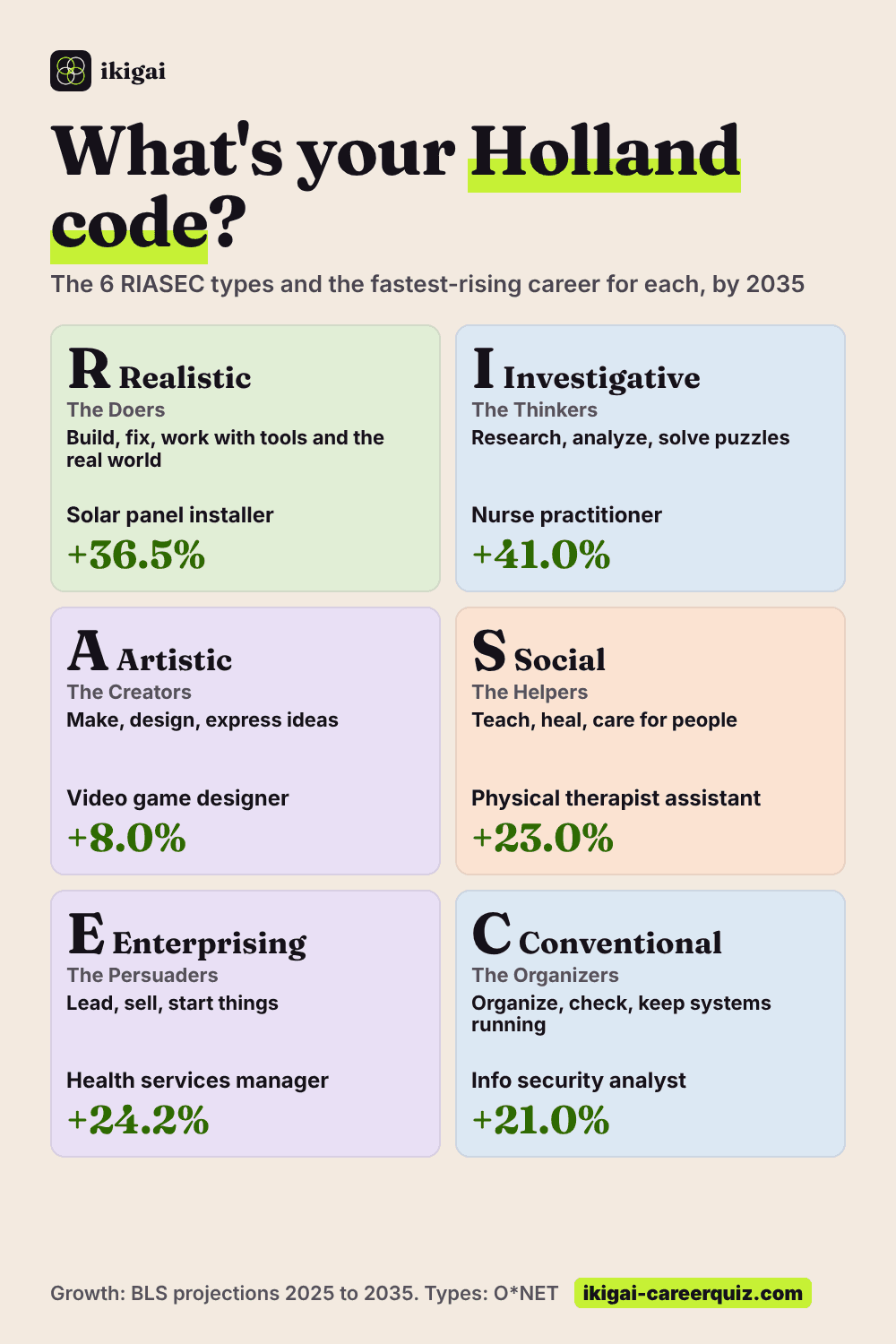
Save the chart
All 6 Holland types and the fastest-rising career for each. Pin it, then send it to the friend who is obviously an E.
Save to PinterestThree things the numbers say
Realistic is the biggest door, not the back door. Hands-on careers make up 41% of our database, and some of the fastest-growing jobs in the country live here: solar installers (+36.5%), wind turbine technicians (+29.5%) and industrial machinery mechanics (+17.8%, with about 446,900 jobs today). The median pay across all Realistic careers ($52,760) is the lowest of the six, but that average hides a wide range: sonographers earn a median of $96,590 after a 2-year degree. If you are an R, skilled trades that pay well is your next read.
Investigative and Social have the most tailwind. Nearly a quarter (23%) of careers in each group are projected to grow at least 8% by 2035, the highest share of any type. Health care is a big reason: it needs both curious problem-solvers and people who are good with people. Investigative careers also have the highest median pay of the six, at $110,105.
Artistic is the plot twist. Only 33 careers have Artistic as their top type, and just 1 of them (video game designers) is projected to grow 8% or more. That is not a reason to give up on creative work. It is a reason to look at your second and third letters. Artistic plus Social points toward roles like art therapists; Artistic plus Investigative points toward design and data visualization. Best careers for creative people maps more of these pairings.
Holland code vs. personality type
People mix up Holland codes with things like the Myers-Briggs (MBTI). They answer different questions. The MBTI-style types describe how you tend to think and recharge. Your Holland code describes what kind of work activities you are drawn to. Holland's model was built specifically for matching people to work, which is why the U.S. Department of Labor's O*NET career tools use it. Personality type still makes a fun lens, and our guide to the best careers by personality type shows how the two line up.
How to find your Holland code
Take a real RIASEC questionnaire. The O*NET Interest Profiler is the standard, and plenty of tools are built on it. Our roundup of the best free career quizzes of 2026 compares the options.
Guess first, then check. Read the six descriptions above and rank them before you take any test. Then compare. The gaps between how you see yourself and what your answers say are often the most interesting part.
Treat it as a compass, not a cage. Interests can shift as you grow up and try things. A Holland code says where your energy tends to go today. It does not say what you will do, and lots of people thrive in jobs outside their top letters.
What Holland could not see: the future
Classic Holland tests stop at "these jobs match you." They match you to the job market as it is today. That is the gap Ikigai was built to fill. We take your RIASEC profile, add how hands-on you like your work, your strengths and your values, then ask what year you expect to start working and weigh each career by its projected growth by then. Same Holland code, future-shifted. More on that in why Ikigai is different.
One honest caveat: BLS projections look about 10 years out. If you will not start full-time work until after 2035, treat these numbers as tailwinds worth exploring, not promises.
Get your Holland code, future-shifted
Our quiz takes about 7 minutes. It finds your RIASEC mix, then ranks all 952 careers in our database by how well they fit you and how fast they are projected to grow by the year you start working.
Take the quiz and see your three letters, plus the rising careers that fit them.
Sources: Interest profiles (RIASEC scores) from O*NET, U.S. Department of Labor. Career growth (2025 to 2035) from BLS Employment Projections; median pay from BLS OEWS (May 2025). Counts of careers by top type, median pay by type (median of occupation medians, reliable wages only), share rising (growth of 8% or more), 3-letter code counts and career picks (growth of 8% or more, at least 10,000 U.S. jobs) via scripts/blog-holland-code-riasec-explained.ts. Holland, J. L., "A Theory of Vocational Choice," Journal of Counseling Psychology 6(1), 1959; Holland, J. L., Making Vocational Choices: A Theory of Careers (Prentice-Hall, 1973). Hexagon structure and research support from EBSCO Research Starters, "Holland's Theory of Career Choice," and Nauta, "The Development, Evolution, and Status of Holland's Theory of Vocational Personalities," Journal of Counseling Psychology (2010). Typical entry paths are common routes, not requirements.
Liked this article?
Get weekly career insights backed by real labor market data. Free, no spam.
Keep reading
Find your Future-Fit Career
7-minute personality quiz. 952 careers. Real BLS data. No account needed.
Take the quiz →