
The Jobs Disappearing by 2035 (and the Ones Taking Their Place), According to the Government's Own Data
One in three typist jobs is projected to vanish by 2035. Here are the 10 fastest-shrinking U.S. jobs, a rising escape route for each one, and the 10 jobs growing fastest, straight from BLS projections.
Founder of Ikigai · Career data + personality science
Two numbers to start your day. In late September, McKinsey estimated that automation could cut U.S. labor demand by about 21% by 2035, roughly 36 million jobs' worth of work, and that around 11 million workers may need to switch to an entirely new occupation. A month earlier, the Bureau of Labor Statistics released its official ten-year projections and named office and administrative support the fastest-shrinking job group in the country: 752,100 jobs gone by 2035.
And it is not hypothetical. Last week Kroger said it plans to cut about 3,000 corporate roles over three years, more than a third of its corporate staff, as it leans into AI.
Every "jobs of the future" article you have read probably led with the winners. We are leading with the losers, because that is the list people actually want to check. Then, for every shrinking job, we found an escape route: a rising career that fits the same kind of person. Same interests, different trajectory.
How we built the list
- The source is the government, not a vibe. Every growth figure is the U.S. Bureau of Labor Statistics projection for 2025 to 2035, the same data behind all 952 careers on this site.
- Real jobs only. We kept occupations with at least 10,000 people working in them today, so nothing on the list is a statistical rounding error.
- Escape routes are matched by personality, not job title. Every career has an interest profile (hands-on, analytical, creative, social, persuasive, organized). For each shrinking job, we looked at the closest-matching careers projected to grow at least 10%, and picked from the top three.
The 10 fastest-shrinking jobs, and an escape route for each
Ranked by projected decline. Click any job for its full profile.
Notice anything?
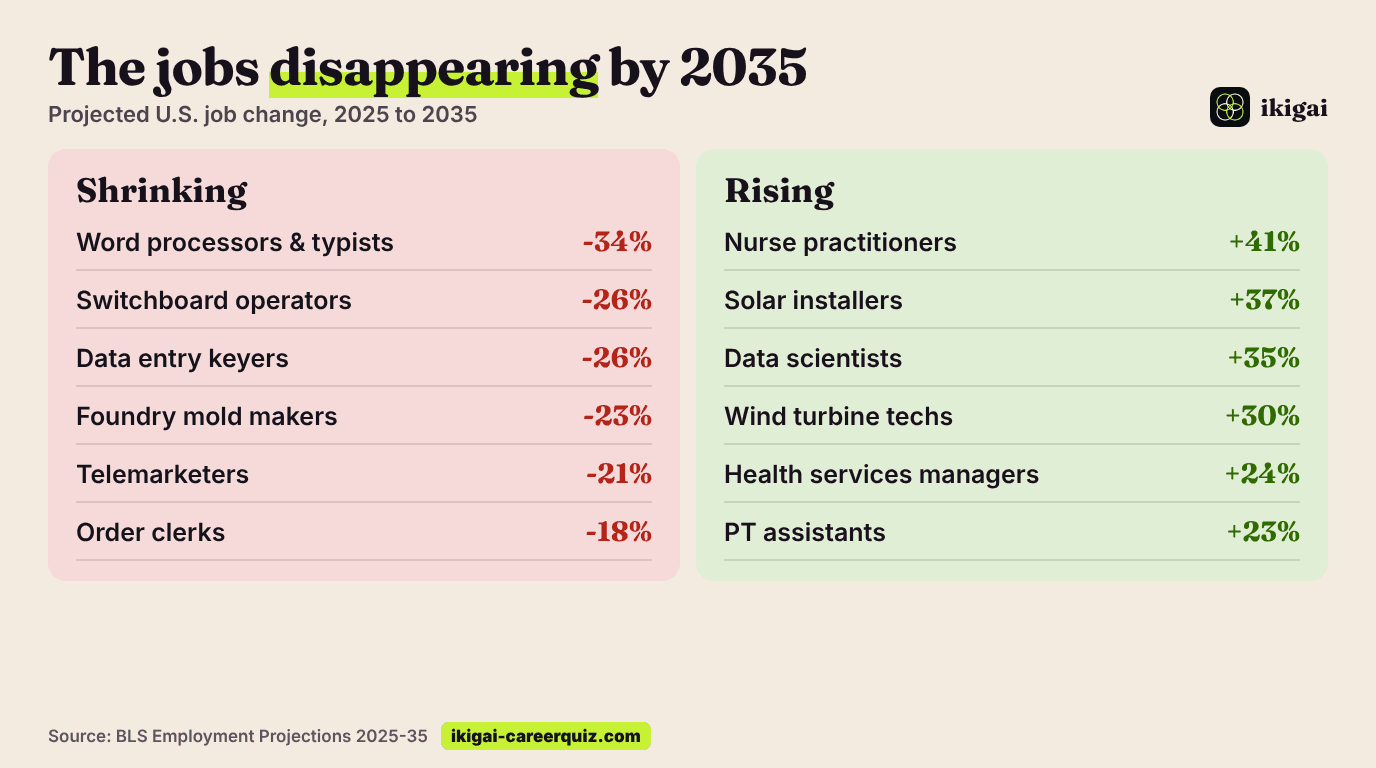
Two patterns jump out. First, the shrinking list is almost entirely office paperwork and factory finishing work: the repetitive, rules-based stuff that software and machines got good at first. That lines up with BLS, which expects automation tools, including AI, to keep pulling down demand for office support jobs.
Second, the escape routes keep landing in the same places: skilled trades and healthcare. Solar installers, power-line workers, HVAC techs, machinery mechanics, medical assistants. Seven of the ten routes skip the four-year degree entirely. If you have spent your life being told the trades are a fallback, the government's own spreadsheet respectfully disagrees. (We made the full case in skilled trades that pay well.)
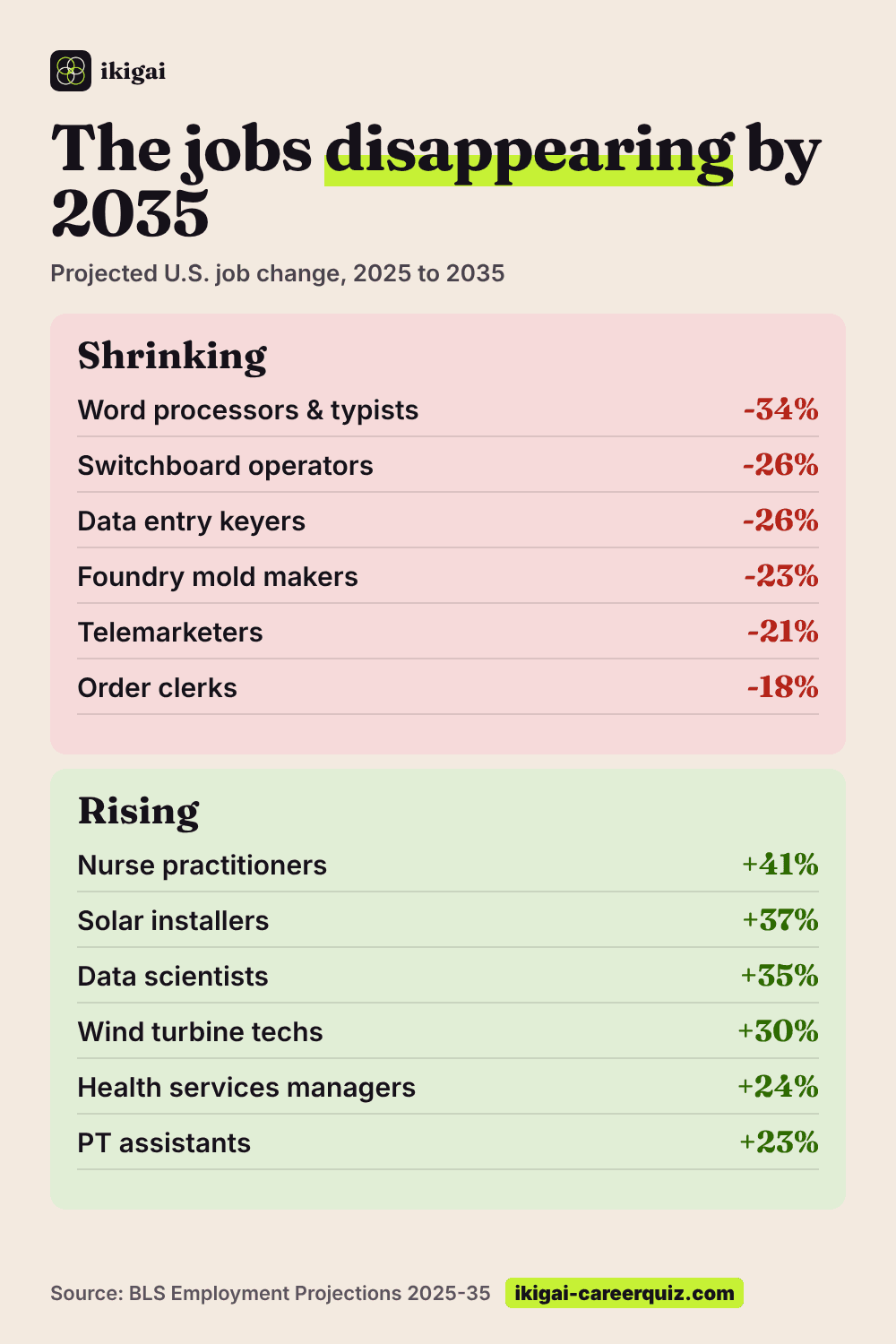
Save the chart for later
Shrinking on top, rising on the bottom. Send it to the friend who still thinks data entry is a safe bet.
Save to PinterestThe 10 jobs taking their place
The fastest-growing jobs through 2035 with at least 10,000 workers today, with median pay and the typical level of preparation.
Healthcare takes six of the ten spots. Clean energy takes two. AI takes two (data scientists and the computer research scientists building the models), which is a nice reminder that the same technology shrinking one list is growing the other. And six of the ten typically need a certificate, an associate degree or short training, not a bachelor's. For the version ranked by how hard each job is for AI to touch, see our AI-proof careers list, or find the most AI-proof job for your personality type.
What this data cannot tell you
- Shrinking is not the same as gone. Data entry keyers are projected to lose a quarter of their jobs, yet the field still has about 7,700 openings a year as people retire or move on. A shrinking job can still hire you. It is just a harder place to build a long career.
- Ten years is the horizon. BLS projects one decade out and assumes technology keeps changing at roughly its historical pace. BLS itself says uncertainty about AI's impact is very high. If you are 16 and will not start full-time work until 2032, treat 2035 as the near edge of your career, not the far one.
- Percentages flatter small jobs. Wind turbine techs grow almost 30%, but that is about 3,500 new jobs. Nurse practitioners add nearly 138,000. Both numbers matter, for different reasons.
- Nobody's future fits on a list. These are tailwinds and headwinds, not instructions. The right move depends on what you enjoy doing all day, and that part is yours.
Is your job on the list?
If your current job (or the one you were planning on) showed up in red, that is not a verdict. It is a head start most people never get. The escape routes above work because they match the person, not the job title, and the same idea scales to all 952 careers in our database.
Our quiz takes about 7 minutes, asks the year you expect to start full-time work, and ranks every career on both how well it fits you and how much demand it is projected to have when you get there. If you want more of the rising side first, browse the fastest-growing careers or the best careers without a degree. Or skip the reading and take the quiz to find your own escape route.
Sources: occupational growth (2025 to 2035), employment, annual openings and median pay from U.S. Bureau of Labor Statistics Employment Projections and OEWS (May 2025). Office and administrative support decline (-4.0%, 752,100 jobs) and BLS notes on AI uncertainty from the BLS Employment Projections news release, August 27, 2026. McKinsey Global Institute automation estimates as reported by Fast Company, September 30, 2026. Kroger corporate job cuts as reported by the Associated Press (October 13, 2026) and Bloomberg via Insurance Journal (October 14, 2026). Escape routes match O*NET interest profiles; they are exploratory, not predictive.
Liked this article?
Get weekly career insights backed by real labor market data. Free, no spam.
Keep reading
Find your Future-Fit Career
7-minute personality quiz. 952 careers. Real BLS data. No account needed.
Take the quiz →