
Trade School vs College: Pay, Debt and 2035 Growth Side by Side
Four years of public in-state tuition runs about $47,800. Two years at a community college, about $8,300. Here are 6 trade careers and 6 college careers side by side, with median pay and projected growth to 2035, so you can compare the paths honestly.
Founder of Ikigai · Career data + personality science
"Trade school vs college" usually gets argued like a sports rivalry. One side posts a plumber's pickup truck. The other side posts a graduation cap. Nobody posts a spreadsheet.
So here is the spreadsheet. Two numbers to start:
- Four years of published tuition at a public in-state university: about $47,800 ($11,950 a year, College Board, 2025-26).
- Two years at a public community college, where a lot of trade and technical programs live: about $8,300 ($4,150 a year).
That gap is real. But tuition is only one column. Pay, growth and how soon you start earning matter just as much, so let's line both paths up the way a smart friend with a calculator would.
Why this question is getting louder
Students are already voting with their feet. The National Student Clearinghouse found that enrollment at vocational-focused public two-year colleges grew almost 20% between spring 2020 and spring 2025, to about 871,000 students. In spring 2026, enrollment in certificate programs rose another 10.2% in a single year.
Meanwhile, about 940,000 people were in registered apprenticeships in fiscal 2024, according to the U.S. Government Accountability Office, roughly half of them in construction. Apprentices earn a paycheck while they train, which flips the usual "pay now, earn later" math of school.
Trade school path: 6 careers rising toward 2035
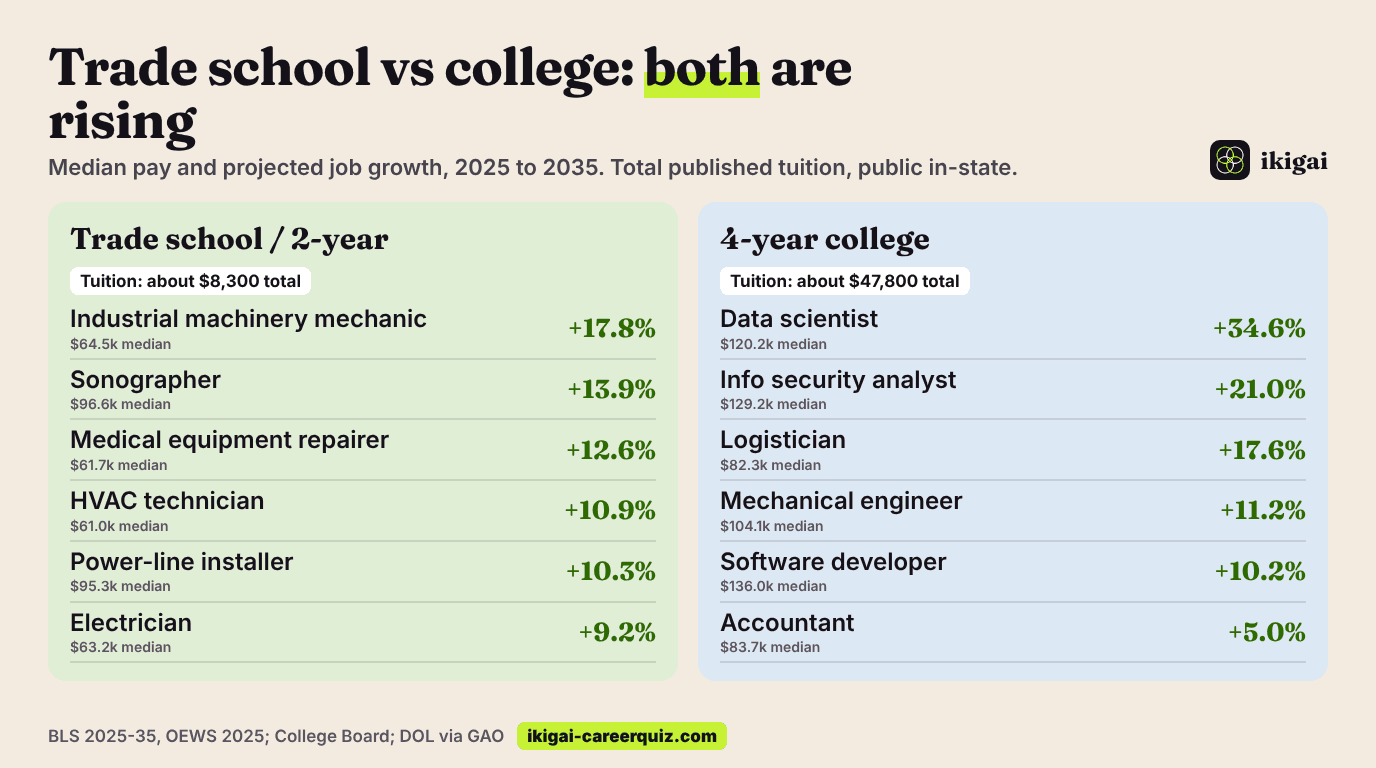
These careers usually start with a certificate, an associate degree or an apprenticeship. All of them are projected by the U.S. Bureau of Labor Statistics to grow by 2035, and all pay a median above $60,000:
Two things jump out. First, the growth numbers are strong, not consolation-prize strong. Industrial machinery mechanics (the people who keep factories and warehouses running) are projected to grow almost 18%. Second, the health care trades pay surprisingly well: a sonographer's median of $96,590 tops many bachelor's-level jobs.
And scale matters. Electricians, HVAC techs and plumbers are not niche jobs: in our data, electricians alone add about 72,700 openings a year. For the highest earners in this group, see trade careers making six figures and our roundup of skilled trades that pay well.
College path: 6 careers rising toward 2035
These usually require a bachelor's degree. The degree here is not a vague credential; it is the actual training the job runs on:
The college column has the higher ceiling. Data scientists are projected to grow 34.6%, one of the fastest rates of any career we track, and software developers earn a median near $136,000. If your interests point at data, systems, engineering or numbers, the degree is often the most direct road in.
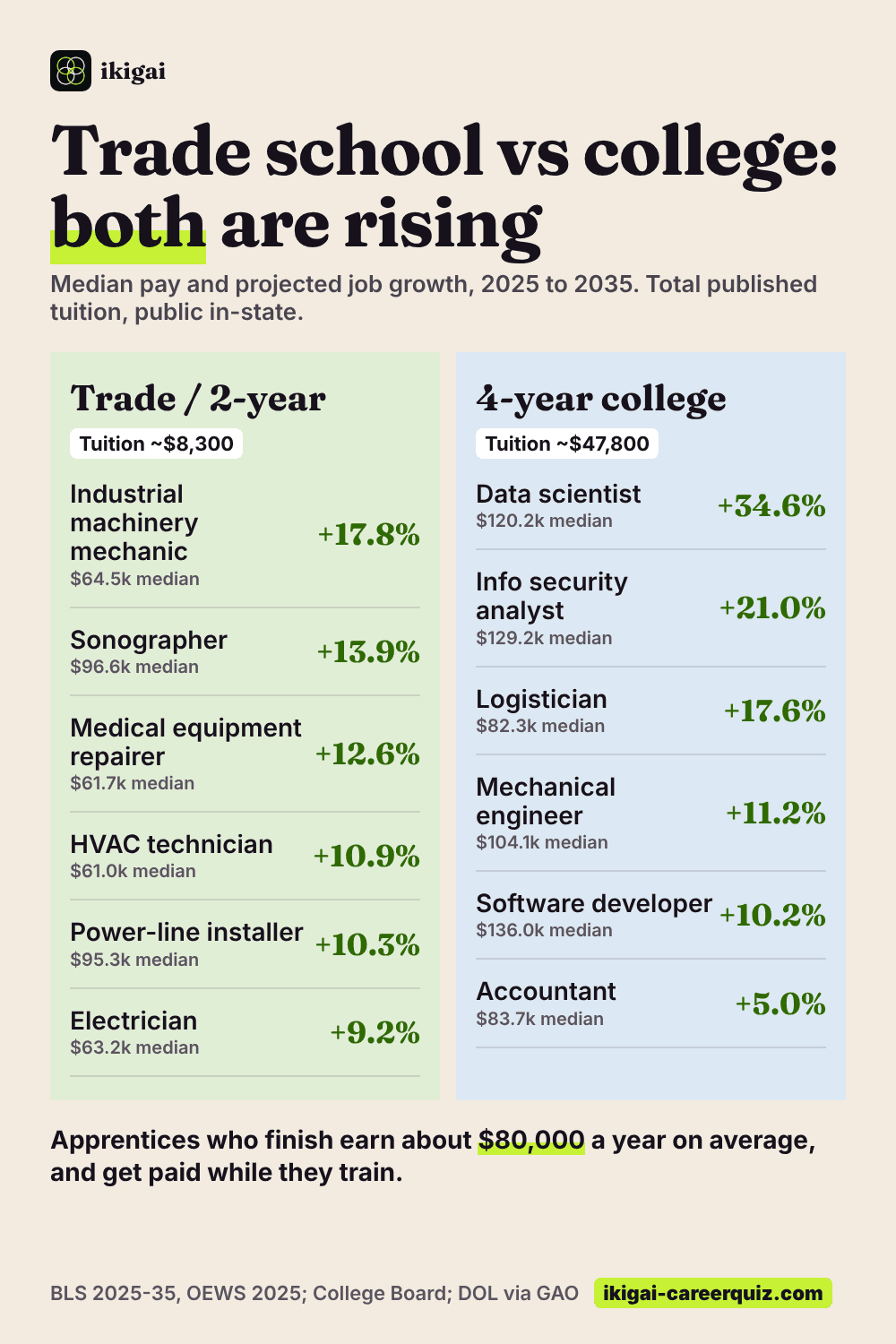
Save the chart
Both paths, side by side: tuition, median pay and 2035 growth. Handy for the "so what are you doing after graduation?" conversation.
Save to PinterestPay, debt and time: the honest scorecard
Pay. On average, the college path pays more. Across our whole database, careers that typically need a bachelor's have a median pay of about $83,050. Hands-on careers that do not need one sit around $50,620. That gap is real, and anyone telling you trades always out-earn degrees is skipping it. But the average hides the spread: pick a strong trade (sonographer, line installer, elevator installer at $109,910) and you can out-earn plenty of degree holders.
Debt. In the class of 2024, 56% of bachelor's grads borrowed, and those who did owed an average of $29,890 (U.S. News data, via WTOP). Many trade programs cost less, and apprenticeships pay you. The U.S. Department of Labor reported that people who completed a registered apprenticeship earned about $80,000 a year on average in fiscal 2023, per the GAO.
Time. A two-year program or a paid apprenticeship can have you earning full wages around age 20, while a four-year grad typically starts at 22. Two extra years of income (and two fewer years of tuition) add up, especially early.
Growth. Both columns above are rising, which is the point of looking at 2035 instead of today. A high school junior will not enter today's job market. They will enter the one in 2029 or 2032, and the careers in both lists are projected to have more jobs then than now.
A 4-question gut check (no wrong answers)
- Do you light up building, fixing or handling real things, or ideas and systems? Neither is better. It is the single biggest clue to which column you might enjoy.
- Which specific careers are you curious about? Compare those, not "trades" vs "college" in general. The averages blur everything.
- What will you actually pay? Use net price after grants for colleges, and ask trade programs about total cost including tools and certification exams.
- Is the career rising when you would start? Look at the 2035 projection, not this year's headlines.
And remember the paths cross. Plenty of electricians later earn a construction management degree, and plenty of graduates go back for a technical certificate. For a deeper look at the degree question, see is college still worth it in 2026, or browse careers without a degree.
What this data cannot tell you
These are national medians and 10-year projections. They cannot see your state, your local union hall, a scholarship offer, or how much you would enjoy the work on a Tuesday in February. Published tuition ignores grants (which lower it) and housing and tools (which raise it). Treat this as a way to ask sharper questions, not as a verdict on which path is right for anyone.
Start with the career, then pick the path
The trade school vs college debate gets easier once you know which careers actually fit you. Our quiz takes about 7 minutes, maps your interests, strengths and values (including how hands-on you like your work), asks what year you expect to start working, and ranks all 952 careers in our database by fit and projected growth by then. Each match shows how people usually get in, apprenticeship, certificate or degree. High schoolers can start with our career quiz for high school students guide.
Take the quiz and see which rising careers fit you, on either path. Parents, here is how Ikigai helps your teen explore careers.
Sources: Published tuition and fees for 2025-26 ($4,150 public two-year in-district; $11,950 public four-year in-state) from College Board, Trends in College Pricing and Student Aid 2025; four-year and two-year totals are those annual figures times four and two. Vocational-focused public two-year enrollment (up almost 20% from spring 2020 to spring 2025, about 871,000 students) from the National Student Clearinghouse Research Center (May 22, 2025). Certificate program enrollment (up 10.2% in spring 2026) from the National Student Clearinghouse (June 4, 2026). Registered apprentices (about 940,000 in FY2024) and average earnings after completion (about $80,000 in FY2023, as reported by the Department of Labor) from GAO, "How Apprenticeship Programs Could Help Fill In-Demand Jobs" (May 2025). Borrowing by bachelor's grads (56% borrowed; $29,890 average, class of 2024) from U.S. News data, via WTOP (June 2026). Career growth (2025 to 2035), annual openings and median pay from BLS Employment Projections and OEWS (May 2025), and group medians (bachelor's-level vs hands-on careers without a bachelor's, by O*NET Job Zone and interest profile), via scripts/blog-trade-school-vs-college.ts. Entry paths are typical routes, not requirements.
Liked this article?
Get weekly career insights backed by real labor market data. Free, no spam.
Keep reading
Find your Future-Fit Career
7-minute personality quiz. 952 careers. Real BLS data. No account needed.
Take the quiz →