
Careers That Help People, Pay Well and Are Still Growing in 2035
12 careers that help people, pay a solid median wage and are projected to keep growing through 2035, from hearing aid specialists (+19.4%) to marriage and family therapists. Half need no 4-year degree.
Founder of Ikigai · Career data + personality science
"I just want to help people" might be the most common answer to "what do you want to do?" It is also one of the least specific. Help people how? With a stethoscope, a whiteboard, a defibrillator, a box of tissues on a coffee table?
Here is the good news: the helping careers are where a lot of the future job growth is. The U.S. Bureau of Labor Statistics projects that private health care and social assistance will add about 2.2 million jobs from 2025 to 2035, roughly 37% of all new U.S. jobs in that decade. Total employment, by comparison, is projected to grow just 3.5%.
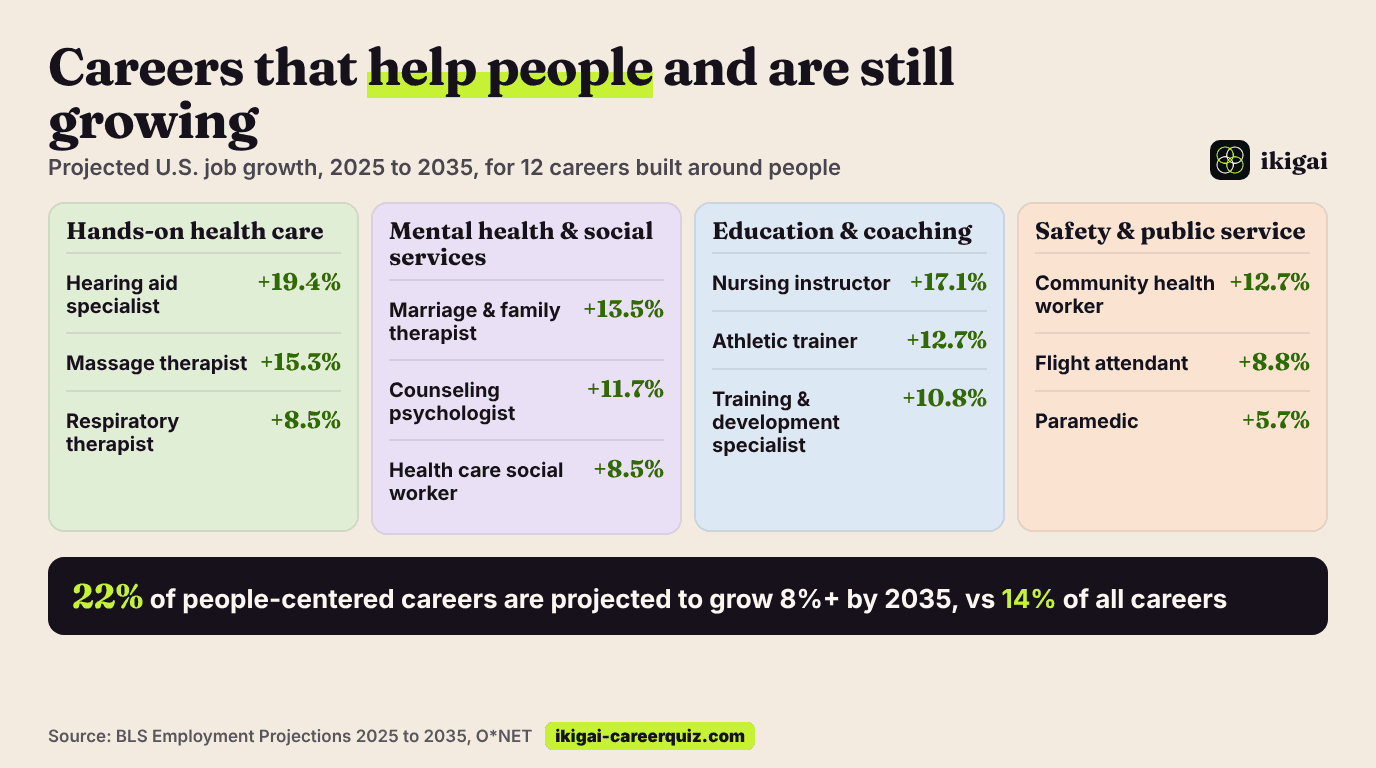
We ran the numbers on all 952 careers in our database. Among the 199 careers where "Social" (helping, teaching, caring) is one of the top two interest types, 22% are projected to grow 8% or more by 2035. Across all careers, it is 14%. People-centered work has a real tailwind.
How we picked these 12
Every career below has Social as its first or second interest type in the U.S. Department of Labor's O*NET data, at least 10,000 U.S. jobs, projected growth of at least 8% from 2025 to 2035, and a median wage of at least $55,000. We sorted them into four ways of helping. The one exception is safety and public service, where we had to lower the bar (more on why below).
We also skipped careers we have already covered in depth. Physical therapist assistants, occupational therapy assistants and nurse practitioners are all here in spirit; you will find them in healthcare careers that are not nursing and best careers for empaths.
One more thing we checked: half of these 12 careers need no 4-year degree, and only 4 typically need grad school. Helping people is not a career path reserved for people with a master's.
You help with your hands, one patient at a time, and you see the difference before they leave the room.
You help people through the hardest stretches of their lives, mostly by listening very well.
You help people get better at something, and you get to watch the moment it clicks.
You help when things go wrong, or you keep them from going wrong in the first place.
Hands-on health care: the fastest route in
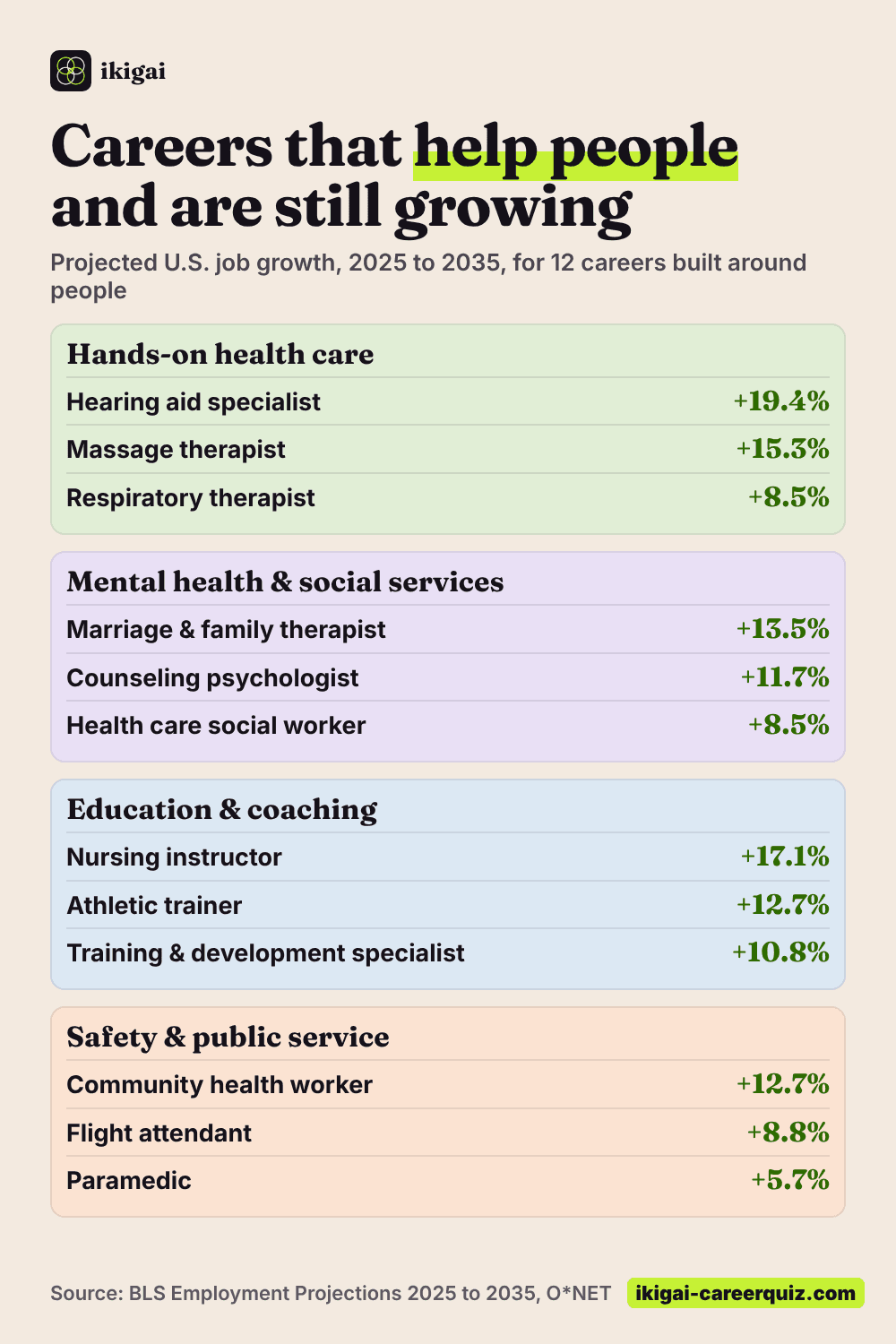
This is the group most career advice skips, and it might be the most practical. Hearing aid specialists top the whole list at +19.4%. An aging population needs more help hearing, and the job mixes people skills (patient, calm, good at explaining) with fitting and adjusting real devices. Respiratory therapists earn a median of $82,280 after a 2-year degree. Massage therapists (+15.3%) train through a certificate program rather than a degree.
If you like seeing a result with your own eyes and hands, these are not a backup plan. They are some of the most direct ways to help a person that exist.
Save the chart
12 careers that help people and are still growing, in four flavors of helping. Pin it for the friend whose answer to everything is "I just want to help."
Save to PinterestMental health and social services: high demand, long runway
Demand for mental health care keeps climbing, and the projections reflect it. Marriage and family therapists (+13.5%) and clinical and counseling psychologists (+11.7%, $100,580 median) are both growing well above the 3.5% average for all jobs. Healthcare social workers are the people who figure out how a patient gets home safely, pays for care and finds support after a hospital stay.
The trade-off is time. These paths usually mean a master's or doctorate plus supervised hours before a full license. If you love the idea but want to test it first, roles like peer support or crisis line volunteering are a low-stakes way to find out whether the work energizes you or drains you.
Education and coaching: where teaching is actually growing
A plot twist from the data: classic K-12 teaching is projected to be roughly flat. Elementary school teachers are at -0.4% and high school teachers at -0.2% from 2025 to 2035. Those are still huge fields with real openings as people retire, but the growth is elsewhere.
It is in teaching adults and athletes. Nursing instructors (+17.1%) are needed because you cannot train more nurses without more people to teach them. Athletic trainers (+12.7%) prevent and treat injuries, from high school sidelines to pro locker rooms. Training and development specialists (+10.8%) teach inside companies, which is a quietly great fit for people who love explaining things but not grading 150 essays.
Safety and public service: steady, not booming
Here is where we had to be honest. Most public safety jobs are projected to grow slowly: police and sheriff's patrol officers +3.5%, firefighters +3.7%. They are stable, respected and hiring, but none cleared our 8% bar, so for this group we used growth of at least 5% and median pay of at least $50,000.
Three careers made it. Community health workers (+12.7%) connect neighbors with care, insurance and services, often in their own community, and many start with a high school diploma. Flight attendants (+8.8%) are, first and foremost, trained safety professionals (the drinks are a side quest). Paramedics (+5.7%) are often the first medical help a person in crisis sees.
The honest part: helping can be hard on helpers
Meaningful work is not the same as easy work. In a CDC survey, 46% of health workers said they often felt burned out in 2022, up from 32% in 2018, and 44% said they were likely to look for a new job in the next year. That is not a reason to steer away. It is a reason to choose your workplace carefully. The same CDC research found health workers did better where they had supportive work environments, trusted management and had a say in workplace decisions.
So when you explore these careers, ask about the job and the place. Staffing, schedules and supervisors matter as much as the title. If you want a calmer starting point, our list of low-stress jobs that pay well has some overlap with this one.
Which kind of helper are you?
Try this quick gut check. Do you want to help with your hands (health care hands-on), with conversation (mental health), with explanation (education) or with action under pressure (safety)? Most people lean clearly toward one or two.
Then ask the bigger ikigai question: is this something the world needs? Every career on this list is projected to be needed more in 2035 than today, which is the "what the world needs" circle in data form. Our post on what the world needs goes deeper on that idea. And if you would rather start working sooner, jobs you can start at 18 includes several helping roles.
One caveat: BLS projections look about 10 years ahead. If you will start working after 2035, treat these as tailwinds worth exploring, not promises.
Find the helping career that fits you
Wanting to help people is a great starting point. Our quiz takes about 7 minutes and turns it into something specific: it finds your interest mix, how hands-on you like your work and what you value, then ranks all 952 careers by how well they fit you and how fast they are projected to grow by the year you start working.
Take the quiz and see which way of helping people is rising for you.
Sources: Interest profiles (RIASEC scores) from O*NET, U.S. Department of Labor. Career growth (2025 to 2035) from BLS Employment Projections; median pay from BLS OEWS (May 2025). Counts of people-centered careers (Social as top or second interest type), share rising (growth of 8% or more) and career picks via scripts/blog-careers-that-help-people.ts. Health care and social assistance share of new jobs: BLS, The Economics Daily, "Utilities fastest job growth, private healthcare and social assistance most new jobs, projected 2025 to 35" (September 2, 2026). Total employment growth: BLS, The Economics Daily, "Total employment projected to grow 3.5 percent between 2025 and 2035" (September 21, 2026). Burnout and job-search figures: CDC Vital Signs, "Health Workers Face a Mental Health Crisis," October 24, 2023. Typical entry paths are common routes, not requirements, and licensing rules vary by state.
Liked this article?
Get weekly career insights backed by real labor market data. Free, no spam.
Keep reading
Find your Future-Fit Career
7-minute personality quiz. 952 careers. Real BLS data. No account needed.
Take the quiz →