What the World Needs: The Half of Ikigai Everyone Skips
Most people treat ikigai as three questions about themselves and quietly ignore the fourth. That fourth circle is the one that decides whether the work still feels worth doing in ten years.
Founder of Ikigai · Career data + personality science
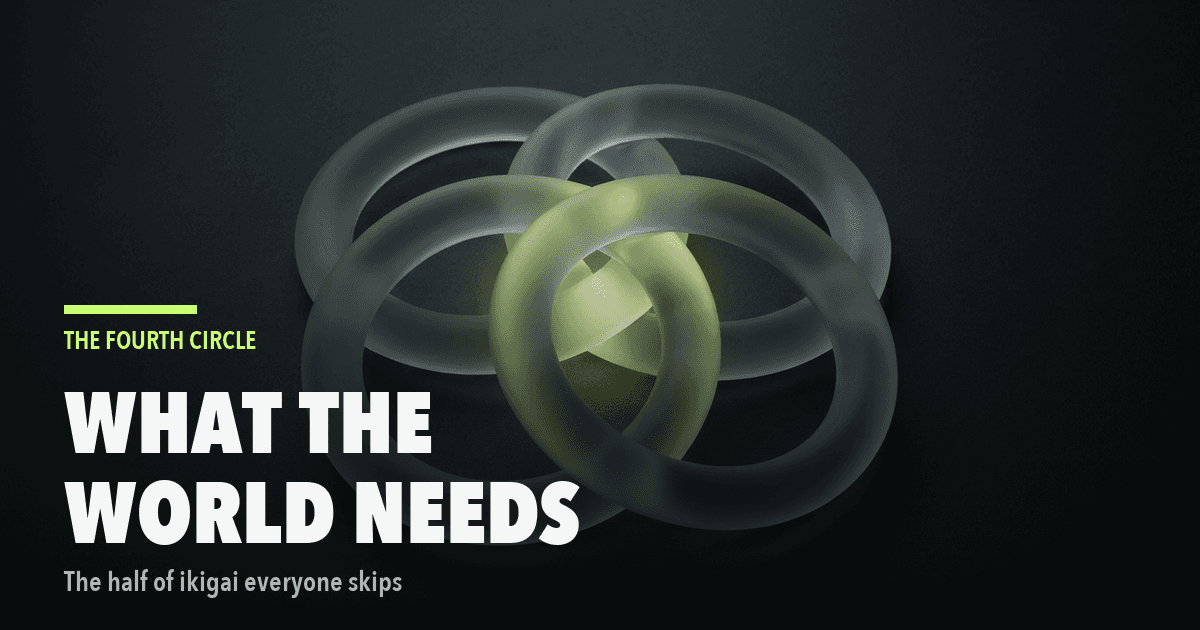
You have almost certainly seen the diagram. Four overlapping circles: what you love, what you are good at, what you can be paid for, and what the world needs. Somewhere in the middle, in the small lens where all four overlap, sits the word ikigai.
Here is what happens in practice. People look at that diagram, and they answer three of the four questions. What do I love? What am I good at? What pays? Those are the ones that feel like they are about you, and they are the ones every career quiz on the internet is built around. Then they glance at what the world needs, decide it sounds like a question for people who want to work at nonprofits, and skip it.
That skipped circle is the reason so many people end up successful and empty at the same time.
Three of the four are about you. One is not.
Look at the four questions again and notice the asymmetry. What you love is about your interests. What you are good at is about your abilities. What you can be paid for is about your market value. All three point inward.
What the world needs points outward. It is the only one of the four that asks about anybody other than you, and it is the only one you cannot answer by introspecting harder. You can sit in a room and figure out what you enjoy. You cannot sit in a room and figure out what the world needs. You have to go and look.
This is precisely why it gets skipped. It is the only question with an external answer, which makes it the only one that requires research rather than reflection. So people optimize the three easy circles, land somewhere that satisfies all of them, and then cannot understand why the work still feels weightless.
It is not a question about charity
The most common misreading is that "what the world needs" means self-sacrifice. Teaching, nursing, social work, aid work. Worthy things, and if they fit the other three circles for you, wonderful. But that is a narrow reading of a much more practical question.
What the world needs is, in plain economic terms, demand. It is the set of problems enough people care about that they will collectively pay to have them solved, for a long time. A cybersecurity analyst is answering a real need. So is a wind turbine technician, a data scientist keeping a hospital system running, an electrician wiring the buildings everyone else works in.
Framed that way, the question stops being sentimental and becomes answerable. And unlike the other three circles, it has actual public data behind it.
Why this circle is the one that protects you
Here is the practical case for not skipping it. The first three circles are all measured against the present. What you love today, what you are good at today, what pays today. Only the fourth circle is inherently about the future, because a genuine, growing need is a claim about the years ahead.
A career that satisfies your interests, your abilities and your salary requirements but sits in a shrinking field is a career with a countdown on it. You will be good at something fewer and fewer people need. The pay erodes, the roles thin out, and the work quietly stops mattering, which you will feel long before you can explain it.
The fourth circle is what makes the other three durable. It is not the idealistic one. It is the defensive one.
How to actually answer it
You answer it with evidence rather than feeling. A few questions that work:
Is the need growing or shrinking? The Bureau of Labor Statistics publishes ten-year employment projections for every occupation it tracks. This is free, public, and almost nobody consults it before choosing a career. A field projected to grow much faster than average is a field where the need is real and compounding.
Is the need structural or fashionable? Aging populations need more healthcare. Electrified infrastructure needs more people who can build and maintain it. Digitized records need people who can secure them. These are structural: they are driven by demographics and physics, not by a trend cycle.
Would anyone notice if this work stopped? An uncomfortable question, and a clarifying one. Some roles would leave a visible hole tomorrow. Others would take months for anyone to miss. Neither answer makes you a good or bad person, but the answer tells you something honest about where the work sits.
Where the four circles actually overlap
These are occupations where the outward-facing circle is strongly satisfied: the projected need is growing well above average, and the work pays enough to be sustainable rather than sacrificial. Whether they also satisfy your first two circles is the part only you can answer.
The version of this that actually helps
A career that satisfies only the fourth circle is martyrdom. A career that satisfies only the first three is the quiet emptiness a lot of high-achieving people describe and cannot name. The point of the diagram was never any single circle. It was the overlap.
Most career quizzes stop at personality, which means they can only ever answer the first two circles. That is why we built the assessment around all four: your interests and strengths, cross-referenced against real occupations, weighted by what the labor market projects the world will actually need. The fourth circle is the one everybody skips. It is also the one that decides whether you still want the job in 2035.
Liked this article?
Get weekly career insights backed by real labor market data. Free, no spam.
Keep reading
Find your Future-Fit Career
5-minute personality quiz. 952 careers. Real BLS data. No account needed.
Take the free quiz →