
Not Passionate About Anything? How to Pick a Career Anyway
42% of recent college grads are working jobs that do not need their degree. If you have no burning passion, you are not broken. Try the 10-minute curiosity audit, plus 10 rising careers built for people with mixed interests.
Founder of Ikigai · Career data + personality science
Here is a number that should make everyone relax a little. According to the Federal Reserve Bank of New York, 42% of recent college graduates were underemployed in the second quarter of 2026, meaning they work jobs that do not usually need a degree. Another 5.6% were unemployed. A lot of those people had a major, a plan and, presumably, a passion.
So if you are staring at the ceiling thinking "I am not passionate about anything, what is wrong with me," the honest answer is: probably nothing. Passion was never the thing that sorted people into good careers. It mostly shows up later, and it shows up for people who picked something reasonable and got good at it.
This post is the permission slip, plus a 10-minute exercise and 10 rising careers that are unusually good fits for people with no single obsession.
First, the permission slip
Most people do not have one blazing interest. They have a handful of medium ones: you like fixing things, you are the friend who plans the trip, you fall into a documentary hole once a month. That is not a personality flaw. That is what a normal interest profile looks like.
It is also very common not to have it figured out. In Gallup's survey of 16 to 24 year olds, only about 4 in 10 high school students said they had thought "a lot" about the career they want. Even among seniors it was about half. If you are 22, 27 or 35 and still unsure, you are in a very large club.
We wrote about the bigger version of this argument in how to find your passion. This post is for the step before that: when you cannot even find a starting point.
Passion usually shows up second
In a set of five experiments with 470 participants, Stanford psychologists Paul O'Keefe, Carol Dweck and Gregory Walton looked at what happens when people believe interests are fixed things you "find" versus things you develop. Students got excited by a fun video about black holes, then read a hard scientific article on the same topic. The excitement dropped fast, and it dropped most for people who believed passion is something you either have or do not.
The researchers' read: when things got hard, those people took the difficulty as a sign that it was not their passion after all. Their suggestion was to swap "find your passion" for "develop your passion."
Translation for your career: the feeling you are waiting for is usually a result, not a requirement. It tends to arrive after you are competent enough that the work stops feeling like flailing.
Replace one impossible question with three easier ones
"What is my passion?" is a terrible question because there is no way to check your answer. These three are checkable, and together they are basically the ikigai idea with the mysticism removed:
- What are you curious enough to be bad at for a while? Not what you love. What you would tolerate learning. That is a much lower, much more honest bar.
- What do people already ask you for help with? Career author Tom Rath, a former Gallup researcher, recommends exactly this in a Yahoo Finance interview this summer: notice what friends and colleagues keep coming to you for. It is a cheap, outside read on your aptitude.
- What will the world be hiring for when you are ready? This is the one nobody asks. A great fit with a shrinking field is a hard road. (See the jobs disappearing by 2035 for what that looks like.)
Interest plus aptitude plus demand beats passion alone, mostly because you can actually measure all three.
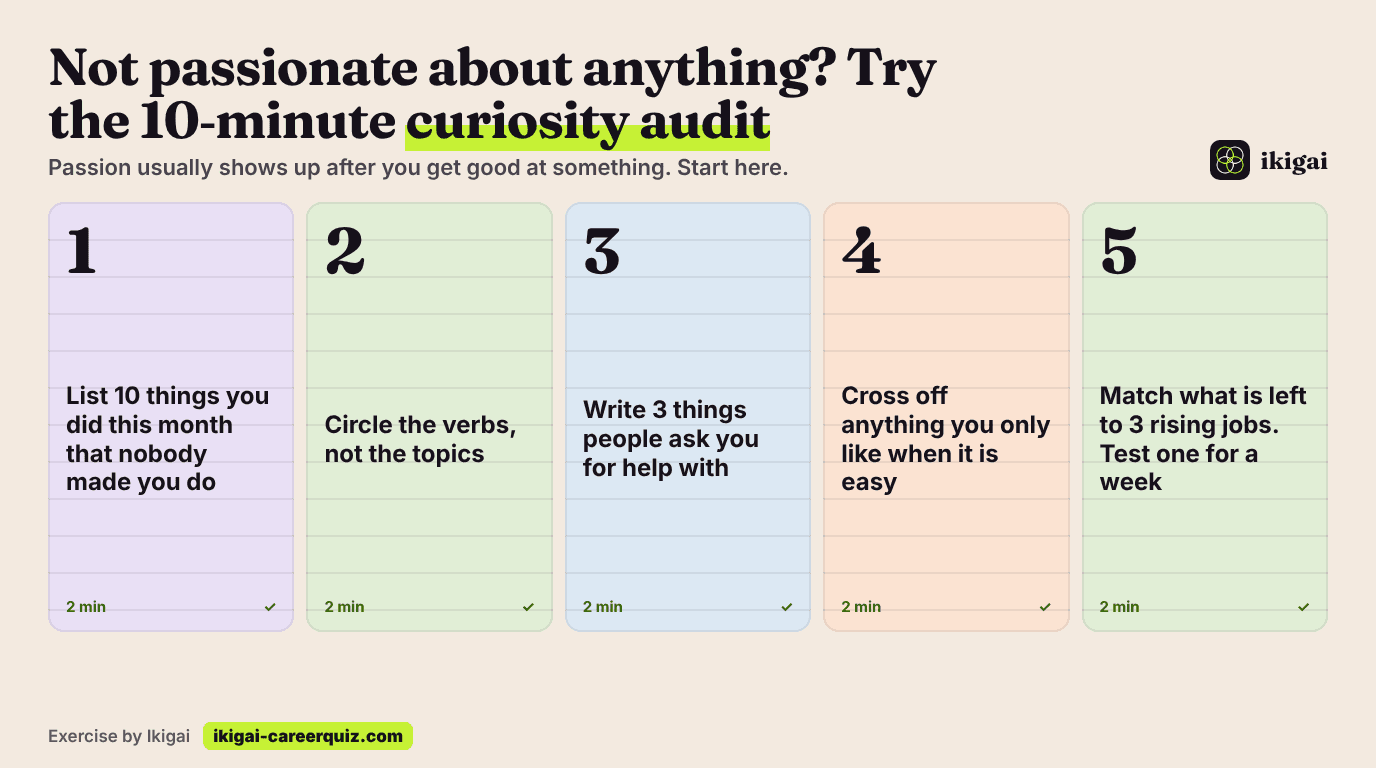
The 10-minute curiosity audit
Grab a notes app or a scrap of paper. Set a timer. Two minutes per step, no overthinking.
- List 10 things you did this month that nobody made you do. Videos you watched to the end, a thing you fixed, a group chat you organized, a recipe you tweaked, an argument you researched way too hard. Small counts.
- Circle the verbs, not the topics. "Watched car restoration videos" is not about cars, necessarily. It might be about fixing, or about before-and-after. Look for repeats: building, explaining, organizing, persuading, caring for, figuring out.
- Write 3 things people ask you for help with. Editing their resume, setting up their TV, talking them down before a hard conversation, planning the budget. These are skills other people have already noticed.
- Cross off anything you only like when it is easy. This is the Stanford lesson. If you love the trailer but hate the homework, that is entertainment, not a lead. Keep the things you would still poke at on a frustrating day.
- Match what is left to 3 rising jobs, then test one for a week. Watch day-in-the-life videos, read a career profile, message one person who does it, or try a free intro course. You are not choosing a life. You are running a cheap experiment.
If step 5 stumps you, that is the exact problem our quiz is built for. It turns your mix of interests into a ranked list of careers that fit and are projected to grow by the year you would start.
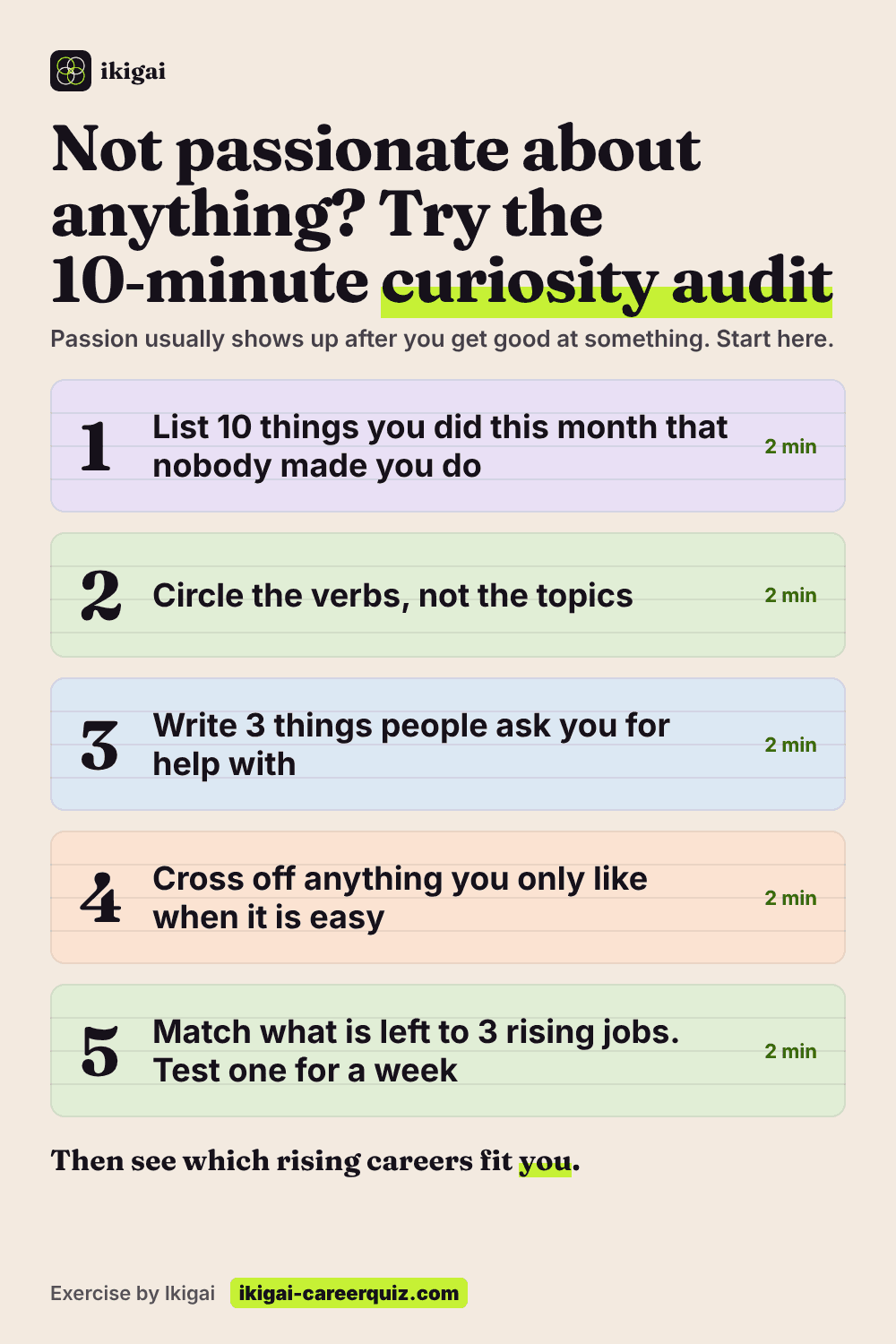
Save the audit for later
All five steps on one page. For the next time someone asks what you want to do with your life.
Save to Pinterest10 rising careers for people with no single passion
Here is a data idea we liked. Every career in the government's O*NET database has an interest profile across six areas (hands-on, science, creative, helping, leading, organizing). Most jobs lean hard on one or two. A small group draws on several almost equally. If your own interests are "a bit of everything," those flat-profile jobs are a natural place to look.
We measured the gap between each job's strongest and third-strongest interest. Across all 952 careers in our data, only about 1 in 9 has a gap of one point or less on O*NET's seven-point scale. Then we kept only jobs with at least 20,000 workers, a published median wage and projected growth of 8% or more from 2025 to 2035. These 10 rose to the top:
Notice the pattern. Eight of the 10 are hands-on, and half do not typically require a bachelor's degree. Mixed-interest people often get steered toward vague office jobs because they "could do anything." The data says many of the best fits are clinics, job sites and cabins at 35,000 feet. If any of these surprise you, we went deeper in the fastest-growing jobs with two years of training.
The 5-year drift trap
The real risk of having no passion is not picking the wrong career. It is picking nothing, on purpose, while you wait to feel sure. That looks like one temporary job that becomes five years, a grad school application as a way to postpone the question, or a fourth personality test that tells you the same thing as the first three.
Drift is sneaky because every individual month looks reasonable. A few ways out:
- Pick a direction, not a destiny. A two-year bet on a growing field is reversible. Five years of waiting is not.
- Set a test date. Run the curiosity audit, pick one job to test, and give it 30 days before deciding anything.
- Count skills, not feelings. If you are learning things a growing field pays for, you are not stuck, even on days it does not feel inspiring.
If you are already a few years in and feel stuck, our quarter-life career change guide covers how to switch without starting from zero.
Find careers that fit your mix
You do not need a passion to take our quiz. You just need to answer honestly. It takes about 7 minutes, maps your interests, strengths and values, asks when you expect to start full-time work, and ranks all 952 careers in our database by how well they fit you and how they are projected to grow by then. Think of it as step 5 of the audit, done for you.
Not sure where to begin? Start with what career is right for me, or go straight to the quiz and see which rising careers line up with the things you already do for fun.
Sources: recent-graduate unemployment and underemployment (ages 22 to 27, 2026 Q2) from the Federal Reserve Bank of New York, "The Labor Market for Recent College Graduates." Career-planning figures from Gallup's survey of 1,928 U.S. 16 to 24 year olds (April 2025). Interest experiments from O'Keefe, Dweck and Walton, "Implicit Theories of Interest," Psychological Science (2018), as summarized by Stanford University. Tom Rath interview by Kerry Hannon, Yahoo Finance (July 4, 2026). Interest profiles from O*NET; career growth (2025 to 2035), employment and median pay from U.S. Bureau of Labor Statistics Employment Projections and OEWS (May 2025). Typical entry paths are common routes, not the only ones. The "flat profile" ranking is our own analysis, offered as exploration, not prediction.
Liked this article?
Get weekly career insights backed by real labor market data. Free, no spam.
Keep reading
Find your Future-Fit Career
7-minute personality quiz. 952 careers. Real BLS data. No account needed.
Take the quiz →