
Part-Time Jobs for Teens That Actually Lead Somewhere
A part-time job is a free career test drive. 8 classic teen jobs, the skill each one builds, and the rising careers they lead toward, like wind turbine technicians (+29.5% by 2035). Plus the federal hour rules for 14 to 17 year olds.
Founder of Ikigai · Career data + personality science
Every summer, millions of teenagers take a job for one reason: money. Fair. But a part-time job is also something nobody advertises. It is a free test drive of a whole career field, paid for by someone else, with zero commitment. You get to find out if you like hospitals, kitchens, animals or power tools before you spend a dime on training.
Lots of young people are already in the driver's seat. In July 2026, 21.3 million Americans ages 16 to 24 had a job, according to the U.S. Bureau of Labor Statistics. A quarter of them worked in leisure and hospitality, and another 18% in retail. Those are the classic teen jobs. The trick is picking one that points somewhere you might actually want to go.
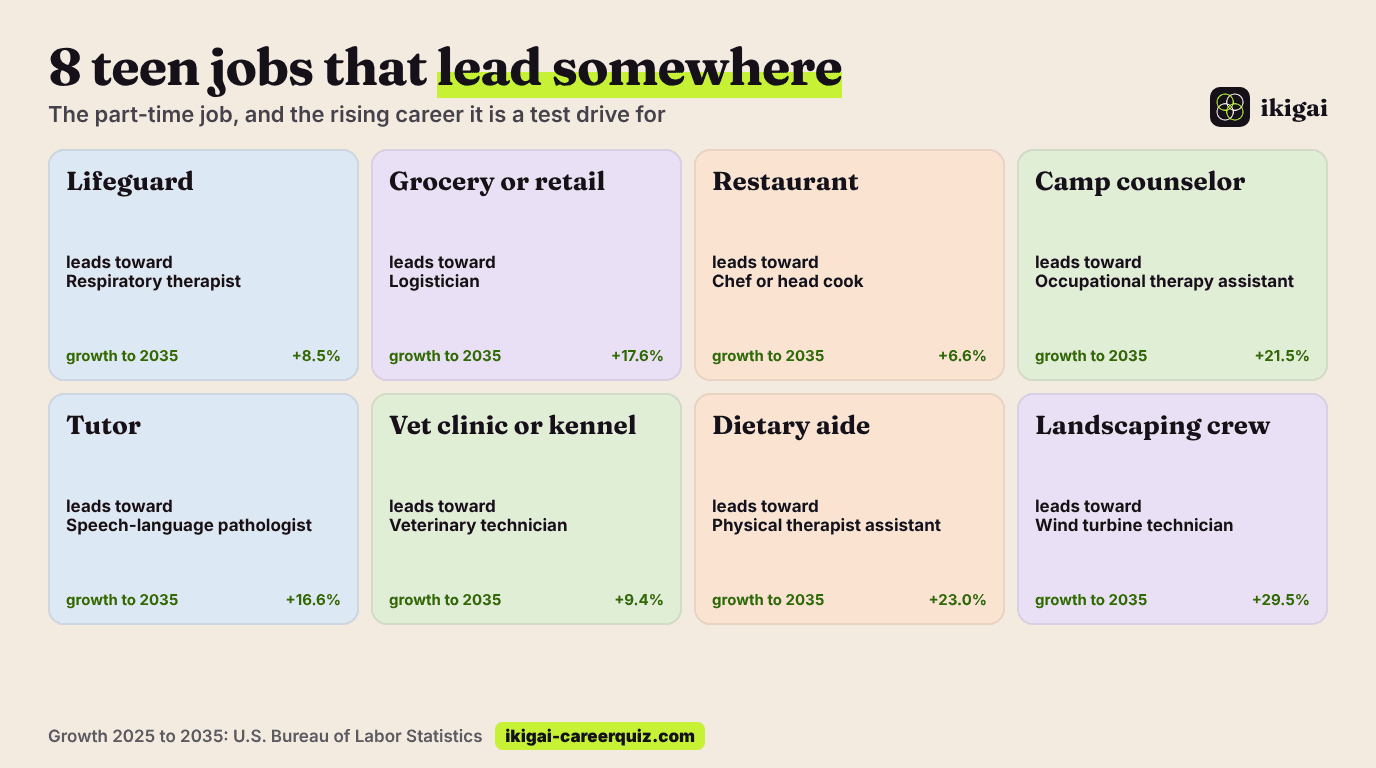
So we took 8 of the most common teen jobs and matched each one to the rising careers it is a stepping stone toward, using BLS projections for 2025 to 2035. The top of the list: a summer on a landscaping crew is real preparation for wind turbine technicians, one of the fastest-growing jobs in the country at +29.5%.
First, the rules (the boring part that matters)
Before you apply anywhere, know what is legal for your age. Under the federal Fair Labor Standards Act, enforced by the U.S. Department of Labor:
- Under 14: most regular jobs are off-limits under federal law.
- 14 and 15: outside school hours only. No more than 3 hours on a school day (Fridays count), 18 hours in a school week, 8 hours on a non-school day and 40 hours in a week without school. Work has to happen between 7 a.m. and 7 p.m., stretched to 9 p.m. from June 1 to Labor Day.
- 16 and 17: no federal limit on hours, but jobs the Labor Department calls hazardous (like driving on the job, roofing, and running power-driven saws or hoists) stay off-limits.
- 18: federal youth rules no longer apply.
One big catch: your state may be stricter, and when it is, the stricter rule wins. Many states also require a work permit. Check your state's labor department site before you start.
8 part-time jobs for teens, and where they can lead
For each job: who can usually do it, the skill it quietly builds, and two rising careers it is a natural test drive for (with projected growth from 2025 to 2035 and median pay). Tap any career to see its full profile.
Why these pairings make sense
Lifeguards spend hours watching for the moment something goes wrong. That is the core of emergency and respiratory care. Respiratory therapists (+8.5%, median $82,280) usually need an associate degree, and your CPR certification is a head start, not a footnote.
Grocery and retail is the surprise. Retail salespersons themselves are flat in our data (-0.3% by 2035), even though the job still has about 520,600 openings a year from people moving on. But the teen who notices why the shelves are empty on Tuesdays is thinking like a logistician, a career projected to grow 17.6%.
Camp counselors already do a version of what occupational therapy assistants do: turn activities into progress for someone who needs help. OT assistants are projected to grow 21.5% on an associate degree, with a median of $72,300.
Dietary aides get something money cannot buy: a real look at how a hospital or care home runs. If you like it, physical therapist assistants (+23.0%, associate degree) and nurse practitioners (+41.0%, the fastest-growing career on this list) are both reachable from there. If you hate it, you just saved yourself years.
Landscaping and construction helpers are not taking a lesser path. Comfort outdoors, with tools and with physical work is exactly what wind turbine service technicians (+29.5%) and electricians (+9.2%) need, and both are usually reached through technical school or a paid apprenticeship instead of a 4-year degree. More on that route in jobs you can start at 18 that still pay well.
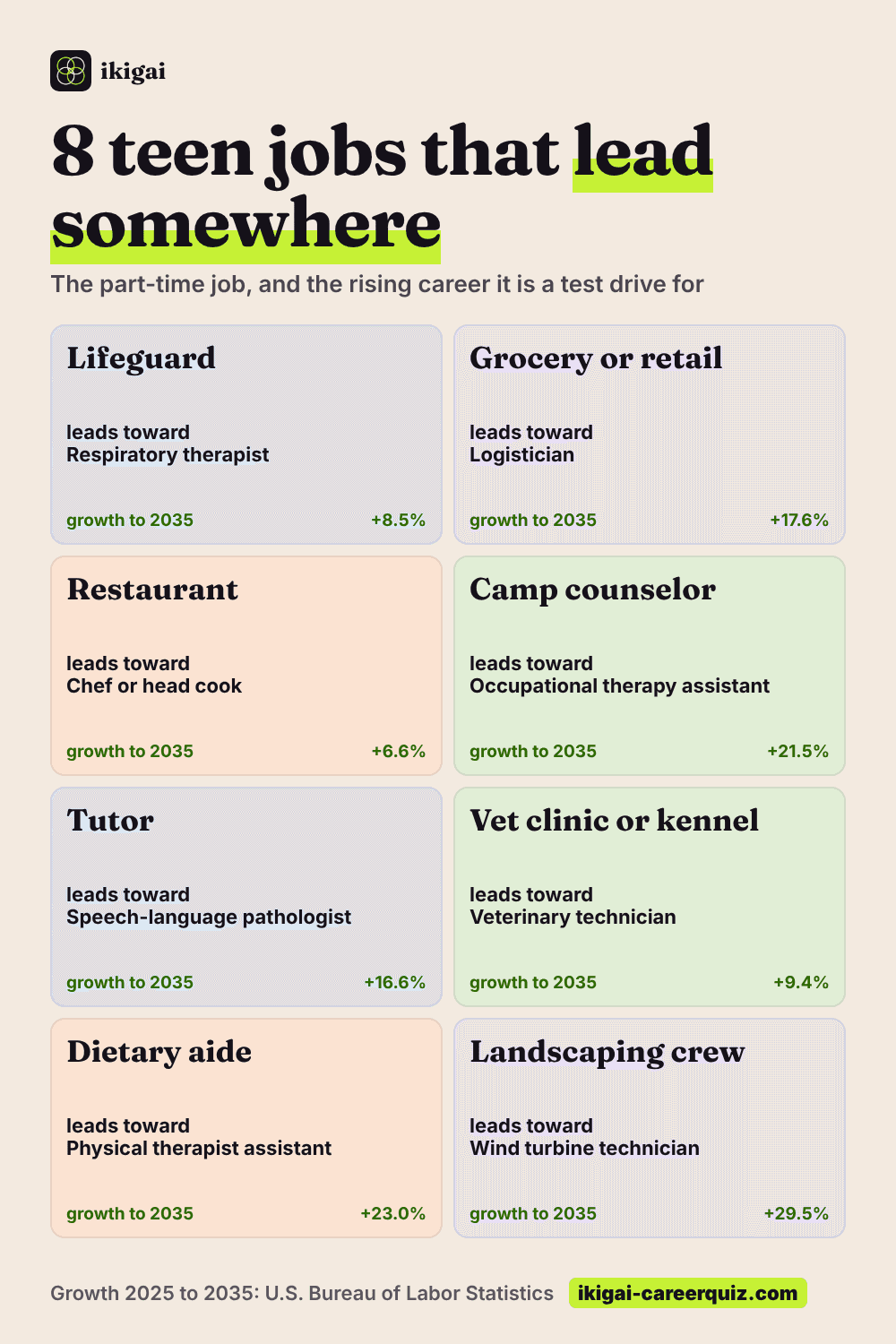
Save the chart
8 teen jobs and the rising careers they are a test drive for. Pin it for the next time someone asks what your summer job is for.
Save to PinterestHow to turn any job into a test drive
Ask one nosy question a week. "How did you end up doing this?" works on almost anyone, from the head cook to the vet tech to the shift manager. You will collect real career paths, which beat any brochure.
Notice what drains you and what does not. Ten minutes after a shift, which part do you still feel good about? The rush, the quiet, the people, the fixing? That is data about you, and it is more useful than the paycheck.
Keep a two-line brag list. Every month, write down one thing you handled well. By the time you apply for college, a program or an apprenticeship, you will have real stories instead of "I am a hard worker."
A job you hate still counts. Finding out you never want to work in a kitchen is a result, not a failure. You crossed something off for free.
A note on the numbers
These projections look about 10 years out, and local markets differ. If you will not start full-time work until 2030 or later, treat them as tailwinds to explore, not promises. And none of these pairings is a rule. A lifeguard can become a software developer. The point is to notice which parts of the job light you up, then look for careers built around those parts. Not sure where to start? See what to do after high school.
Find the career your summer job is pointing at
Our quiz takes about 7 minutes. It maps your interests, strengths, values and how hands-on you like your work, asks what year you expect to start working, and ranks all 952 careers in our database by fit and projected growth by then. It is built for high schoolers, the same way our career quiz for high school students guide explains.
Take the quiz and see which rising careers fit you. Parents, here is how Ikigai helps your teen explore careers.
Sources: Career growth (2025 to 2035), annual openings and median pay (May 2025) from BLS Employment Projections and OEWS, via scripts/blog-part-time-jobs-for-teens.ts. Youth employment (21.3 million employed ages 16 to 24 in July 2026; 25% in leisure and hospitality, 18% in retail trade) from BLS, "Employment and Unemployment Among Youth, Summer 2026" (Aug 20, 2026). Hour limits, hazardous occupations, lifeguard rules and the stricter-law rule from U.S. Department of Labor Wage and Hour Division, Fact Sheet #43 (Child Labor Provisions for Nonagricultural Occupations) and YouthRules. State rules may be stricter. Pairings of teen jobs and careers are our editorial picks based on shared skills, not requirements.
Liked this article?
Get weekly career insights backed by real labor market data. Free, no spam.
Keep reading
Find your Future-Fit Career
7-minute personality quiz. 952 careers. Real BLS data. No account needed.
Take the quiz →